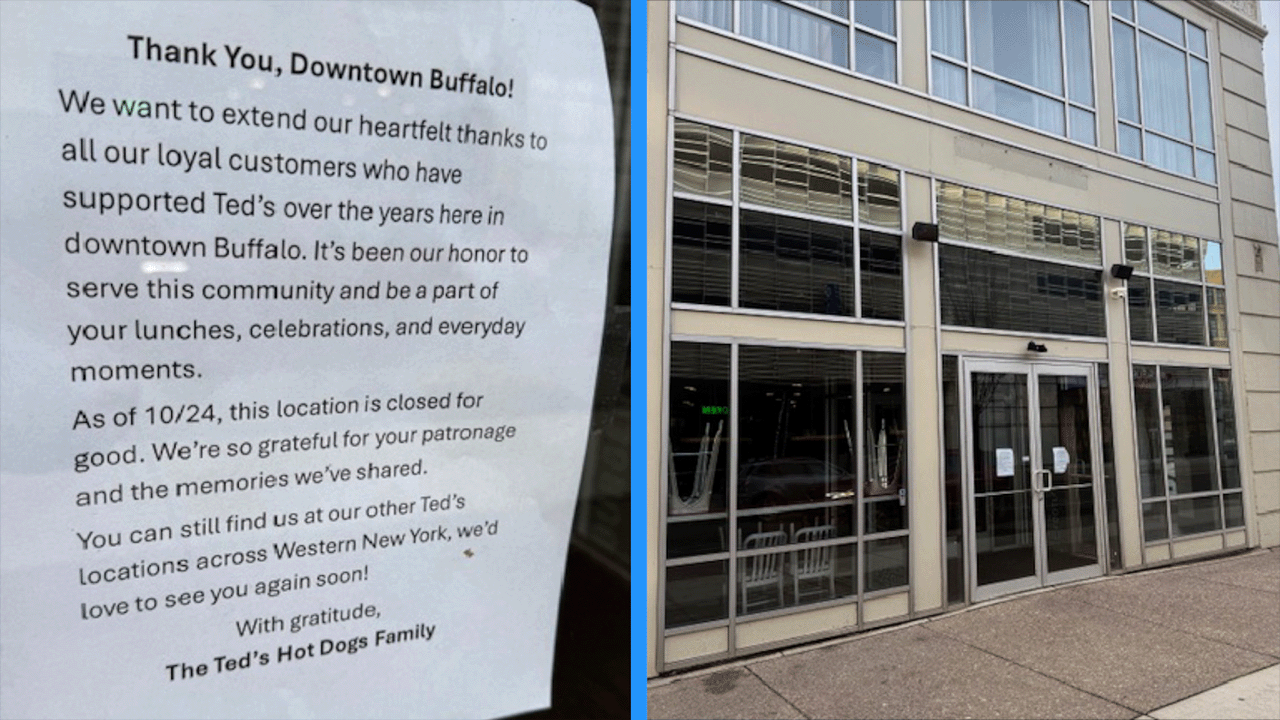

BUFFALO, N.Y. (WKBW) — You can add Ted's Hot Dogs to the list of restaurants that have closed their doors recently in Downtown Buffalo.
The local chain turned out the lights at its location on Chippewa Street, between Delaware and South Elmwood, in late October, ending a 10-year run that saw several stops and starts.
A sign on the door says "As of 10/24, this location is closed for good," and thanks customers for their loyalty, saying, "It's been our honor to serve this community, and be a part of your lunches, celebrations, and everyday moments."
Ted's sat a few doors down from the former home of The Chocolate Bar, which closed in 2022. That storefront has remained vacant ever since. Both businesses are located on the bottom floor of the Hampton Inn and Suites. The spaces are leased by Benderson Development.
A number of restaurants in the central business district have struggled to survive following the COVID-19 pandemic. Dinosaur BBQ, TGI Fridays and Toutant have all closed their doors since May 2025. Misuta Chow's on Main Street shut down in September.

City officials say an estimated 20,000 fewer people are working downtown post-pandemic, as many companies have shifted to remote work. But for downtown businesses looking for some bright spots, there are a few on the horizon.
Ingram Micro is moving more than 1,000 workers from Williamsville to the former home of Blue Cross Blue Shield on West Genesee Street.
D'Youville University is also planning to open its new College of Osteopathic Medicine on Delaware near Chippewa next year, bringing 750 faculty and students downtown.
Senior Reporter Michael Wooten explored the state of downtown post-pandemic in our special Voices: Renaissance Rusting. You can watch his discussion with city leaders, stakeholders and small business owners about the future of downtown below.
Key stakeholders – including leaders in government, academia and business – said the comeback continues.

Mitch Nowakowski – (D) Buffalo Common Council, Fillmore District

“What we find in Downtown Buffalo and even throughout the city, it either has to be luxury or it has to be for a certain demographic of poverty, and we are missing the middle class. We’re missing people who are making $50,000, $60,000, $70,000 that are working professionals, and we’re missing the opportunity to provide them housing to live in our city and in our Downtown core.”
Michael Schmand – Executive Director, Buffalo Place
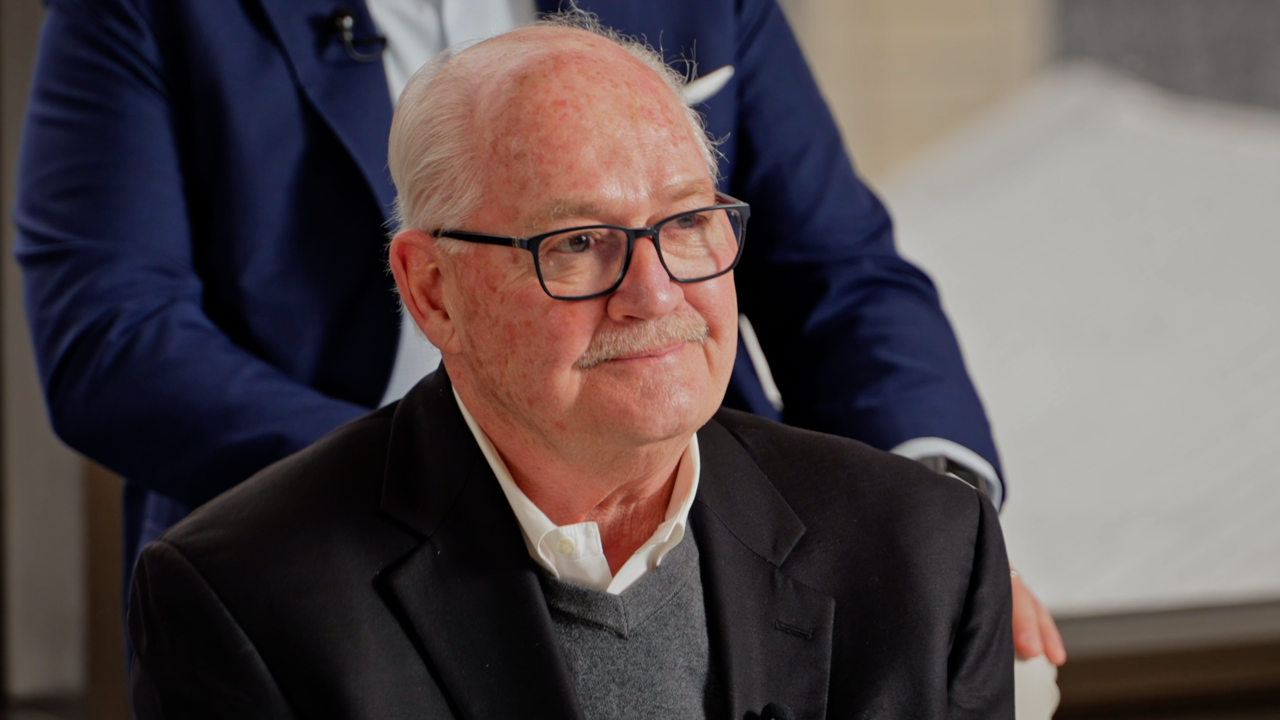
“I’ve been here for quite a while. Bob (Shibley) and I started working the Queen City Hub plan 20-some years ago. That’s when we were rusting. There was nothing going on. There was no traffic on Main Street. We had the train coming up and down. Since then, take a look at the investments that have taken place. The billions of dollars of investment that have taken place in the Downtown core, from Canalside to bringing traffic back to Main Street… Take a look at our waterfront right now. It’s not rusting. Our Downtown isn’t rusting. It’s adapting.”
Albert Ramia – Owner, Sue’s Deli

“Our biggest difference right now (compared to before the pandemic) is lack of patrons, lack of people around, walking around. So we need basically more people back to the offices if we can, and more people Downtown, whether they’re living here or doing business or whatever, just bring people.”
Nadine Marrero – Executive Director, City of Buffalo Office of Strategic Planning

“There are challenges with office buildings and their layouts of making them apartments. You need to have a certain number of windows. You need to have plumbing in the middle. The elevators need to work differently. So there will be challenges in some of these buildings with conversion, but some of them will need to convert. We do not and will not likely see the need for the same amount of office space, and this is a trend we started 20 years ago.”
Robert Shibley – Director, Rudy Bruner Center for Urban Excellence, UB School of Architecture and Planning

“We have to find a richer family of uses for our older buildings Downtown. Too many of them are empty… All of that threatens and challenges us to find new vehicles to support development Downtown that really recognize change of use in Class B, C office to residential or other mixed uses.”
Michael Manning – VP of Leasing, Main Place Liberty Group

“As the office market demand shrinks because people are working from home more and users have less need for space, the (Class) B, the C buildings just are naturally going to suffer.”