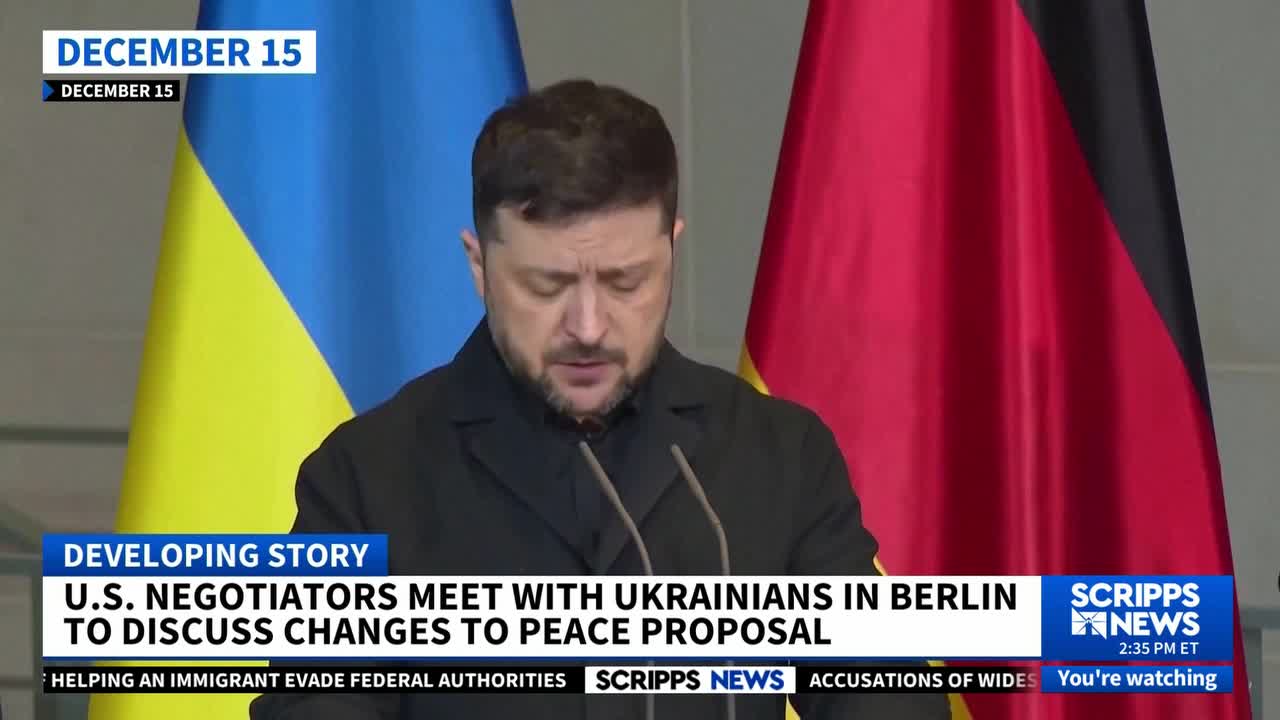


U.S. officials, Ukrainian leaders and European allies wrapped up a weekend of peace talks in Berlin, Germany, on Monday, with the Americans suggesting significant progress was made towards the long-elusive goal of ending the Russia-Ukraine conflict.
Of particular focus during this round of negotiations were security guarantees to protect Ukraine from future Russian incursions. The talks were “really really positive in almost every respect,” a U.S. official present for the talks told reporters Monday afternoon. “Hopefully we are on the path to peace, and we will have proven to be helpful in that endeavor.”
The summit officially concluded Monday evening with a dinner in Berlin, where the U.S. officials leading the talks — including Special Envoy Steve Witkoff and Trump’s son-in-law Jared Kushner — joined Ukrainian President Volodymyr Zelenskyy and his top deputy as well as a host of European leaders.
President Donald Trump phoned into the event from the Oval Office, telling reporters shortly thereafter the leaders had “very long and very good talks.”
“We're trying to get it done. And I think we're closer now, they will tell you that they're closer now… than we have been ever,” Trump said. “At this moment, Russia wants to get it ended. The problem is, they'll want to get it ended, and then all of a sudden they won't. And Ukraine will want to get it ended, and all of a sudden they won't. So we have to get them on the same page.”
Shortly before the dinner began, one U.S. official told reporters he believed the Berlin talks resolved upwards of 90% of the issues between the warring nations, conceding there’s “some more things that have to be worked out” but expressing optimism at the prospect of reaching a peace deal.
Ukrainian and European leaders, for their part, have been far more measured.
Speaking to reporters alongside German Chancellor Freidich Merz ahead of the dinner, Zelenskyy said the U.S. and Ukraine have “different positions” concerning ongoing territorial disputes between Russia and Ukraine and how to resolve them. “I think that my [American] colleagues have heard my personal position. I am very happy that I was able to personally convey this position.”
He later posted a tacit criticism of the timing of the summit, writing that it was “important” for U.S. officials to be read-in on Ukraine’s position about the war but arguing that, “If these meetings had taken place earlier, the progress would have been even greater.”
Security guarantees come into focus
Despite officials’ optimism about progress made towards a security guarantee framework, key questions about U.S. involvement in the pact remain unanswered.
Monday evening, a group of European prime ministers and EU leaders circulated a joint statement providing more clarity about the current proposal. Under the framework they described, the U.S. and Europe would continue to provide support to Ukraine’s military, while Europe would stand up a “multinational force Ukraine,” supported by the U.S., to “assist in the regeneration of Ukraine's forces, in securing Ukraine's skies, and in supporting safer seas, including through operating inside Ukraine.”
The U.S. would further oversee a ceasefire monitoring and verification mechanism with international participation to “provide early warning of any future attack and attribute and respond to any breaches,” and also establish a “deconfliction mechanism” to work on deescalating further conflict.
Importantly, the agreement includes a mechanism similar to NATO’s Article V, which would require “armed force, intelligence and logistical assistance, economic and diplomatic actions” in the event of an attack against Ukraine.
U.S. officials have said the American military will not have “boots on the ground” within Ukraine, but touted the idea of an Article V-like agreement as a major development.
"That's probably the most important pillar of any deal, because you need that to be right in order for this to be lasting,” one official said.
As evidence of how seriously the U.S. is viewing these discussions, U.S. officials noted that Witkoff and Kushner were joined in Berlin by U.S. Air Force Gen. Alexus Grynkewich, who leads both NATO military operations and the U.S. European Command.
His spokesman confirmed to Scripps News that he participated in the talks as a “senior U.S. military representative to provide military advice to U.S. officials in furtherance of President Trump’s pursuit of peace,” but declined to provide any further specifics.
Though Russia has long opposed Ukraine’s accession to the NATO pact, U.S. officials attested to their belief that the Kremlin would agree to the latest framework.
Russian leaders had yet to comment on the developments as of Monday evening.
RELATED NEWS | Zelenskyy visits Ukraine's front line ahead of new rounds of peace talks
Territorial disputes remain
While a plan to ensure long-term peace in the region may be coming into focus, agreement about how to end the current fighting and allocate contested territories remains hotly-debated.
Russian leaders have long demanded that Ukraine cede back significant swaths of territory — even some currently under Ukrainian control — as a means of ending the fighting. Ukrainian leaders have thus far rebuffed such demands.
U.S. officials present for the Berlin negotiations said conversations with their Ukrainian counterparts were “deeper, more more thorough, [and] more robust” than they had been previously, and suggested some of the disputes between Russia and Ukraine had narrowed.
The U.S. provided Zelenskyy with some “thought-provoking ideas” about how to approach the territorial issues, one official said, suggesting the Ukrainian leader would now discuss such proposals with his team.
But Zelenskyy in a post Monday evening noted plainly that the Ukrainians “have different positions with Russia regarding territories,” going on to argue such a fact “must be acknowledged and discussed openly” in order to end the conflict.
American officials in recent weeks had proposed the creation of a demilitarized economic zone in a part of the Donetsk province still under Ukrainian control — brought about by Ukraine’s military withdrawal from the region and the subsequent rebuilding of the area. But Ukrainian and European officials have expressed concerns Russian forces would simply invade the area once Ukraine withdrew, and Zelenskyy has broadly rejected calls for ceding any territory to Russia without a referendum in his nation.
As with other complex matters, U.S. officials on Monday largely dodged specific questions about the status of the territorial negotiations, suggesting talks were ongoing.
Indeed, further meetings were expected in the U.S. later this weekend, officials said, with a focus on maps and U.S. military involvement in the region.