

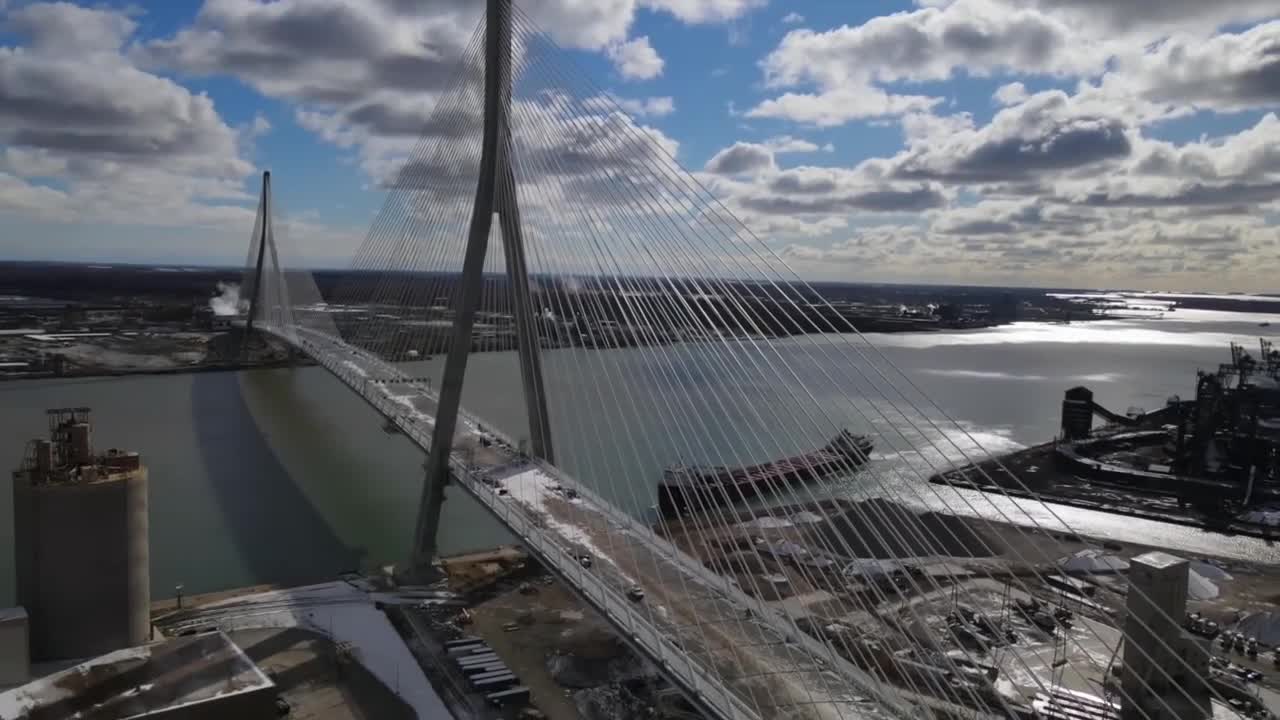


On Monday night, President Donald Trump threatened to block the opening of the Gordie Howe International Bridge, which is being fully paid for by the Canadian government.
In a post on Truth Social, Trump said in part that he would "not allow" the bridge to open "until the United States is fully compensated for everything we have given them, and also, importantly, Canada treats the United States with the Fairness and Respect that we deserve."
Watch below: Trump threatens to block opening of Gordie Howe International Bridge
The bridge is the result of a decades-long process between the United States, the State of Michigan and the Government of Canada. On June 15, 2012, the Government of Canada and the State of Michigan signed the "Canada-Michigan Crossing Agreement," which was pivotal in the process of building the bridge.
You can read the entire agreement in the document below.
Canada-Michigan Crossing Agreement by WXYZ-TV Channel 7 Detroit
That 2012 agreement had several stipulations. They were:
- The International Authority will be comprised of equal representation by Canada and Michigan.
- All iron and steel for any bridge component in Canada and for any component of the project in the United States, will be sourced in either Canada or the United States
- The Government of Canada will pay all costs of the required land acquisition in Canada and Michigan and for the construction of an interchange to provide connections to I-75
- Tolls for both Canada-bound and US-bound traffic will be collected on the Canadian side of the crossing and used to reimburse the Canadian government for the funds it advances related to the project
- The public-private partnership agreement must contain provisions for community benefit plan and for the involvement of the host communities in Canada and Michigan
- The crossing will be publicly-owned, jointly by Canada and Michigan
- The International Authority will be comprised of equal representation by Canada and Michigan.
Watch below: As the Gordie Howe International Bridge nears completion, we visited the site to see the progress
According to the U.S. Department of Transportation, the bridge is being built through a 36-year "design-build-finance-operate-maintain availability payment concession." That means that the Windsor-Detroit Bridge Authority pays the private sector concessionaire, Bridging North America, based on performance.
The total project cost of $5.7 billion CAD ($4.415 billion USD) is being paid for by the Government of Canada. The Windsor-Detroit Bridge Authority also said that separate from the contract with Bridging North America, Canada has invested $559 million CAD ($433 million USD) between 2005 and 2018 to get the project to the point where construction could begin.
Of that, $2.9 billion will be allocated for the design-build phase and $1.5 billion allocated for the operations-maintenance-rehabilitation phase, according to the USDOT. The Government of Canada funding is set to be recouped by future toll revenues over 36 years.
In the Truth Social post, Trump also wrote, "With all that we have given them, we should own, perhaps, at least one half of this asset."
Below are the concessionaire's financing during construction, according to the U.S. Department of Transportation.
- Construction Progress Payments from WDBA - $2.12 billion
- Substantial Completion Payment from WDBA - $374.5 million
- Excluded Design-Build Costs - $26.7 million
- Capital Payments from WDBA - $29 million
- Short-term Bank Debt (repaid by construction progress payments, capital payments, and equity) - $454.8 million
- Medium-term Bonds - $121.7 million
- Long-term Bonds - $224.1 million
- Equity - $72.1 million
- Interest - $0.1 million
This is a similar plan to how the Blue Water Bridge in Port Huron was built in the 1930s. According to the State of Michigan, the state legislature approved a law creating a state bridge commission in 1935. That plan was later approved by U.S. Congress and the commission was given permission to sell bonds that would be repaid by the revenue.
Then, the U.S. and Canadian governments agreed to operate the bridge toll free when the bonds were paid off in February 1962.
This story was originally published by Scripps News Detroit.
