



Oil prices plunged below $95 per barrel, and stock markets surged worldwide Wednesday after President Donald Trump pulled back from his threat to destroy Iran.
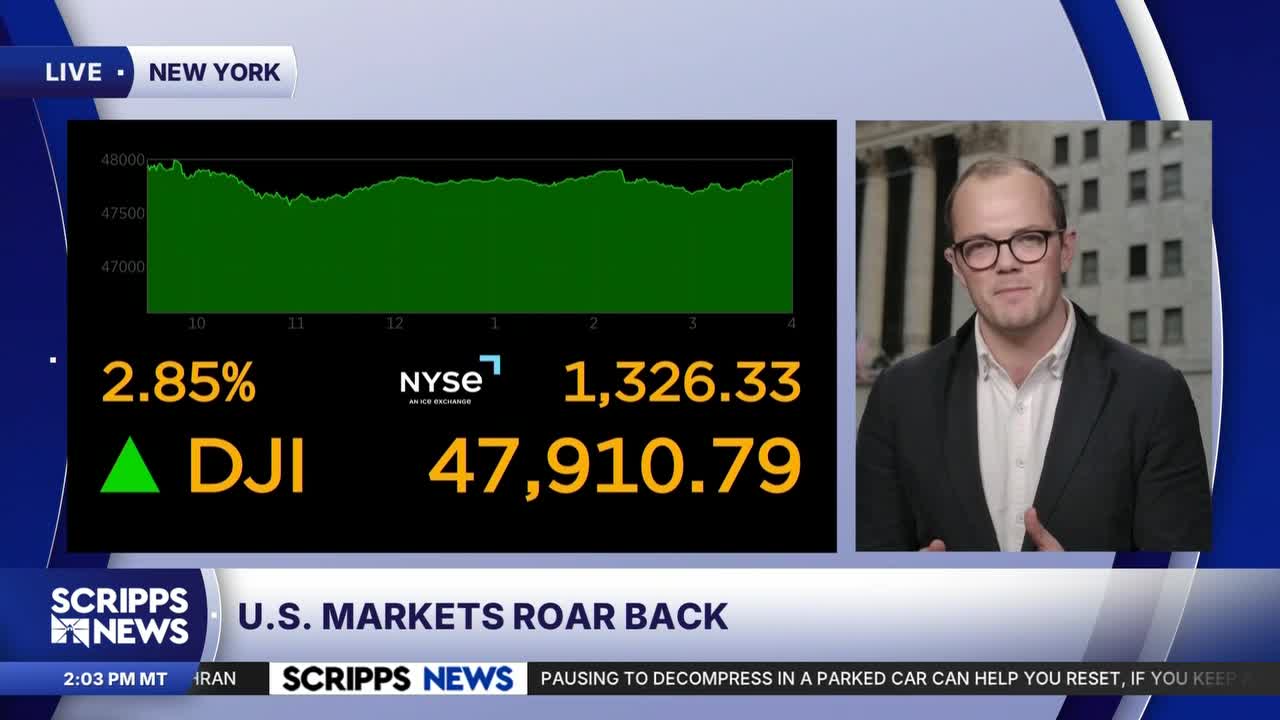
The S&P 500 leaped 2.5% after Trump announced a two-week ceasefire with Iran, less than 90 minutes before a deadline Trump had set for it to open the Strait of Hormuz and allow oil tankers to exit the Persian Gulf. The Dow Jones Industrial Average rallied 1,325 points, or 2.8%, and the Nasdaq composite soared 2.8% following even bigger gains in European and Asian stock markets.
To be sure, stock prices are still below where they were before the war. And oil prices are still higher because of the threat of a resumption to the war. The ceasefire already looks precarious, and dueling reports from Iran state media and the White House disagreed Wednesday on whether Iran had closed the Strait of Hormuz again.
RELATED STORY | Iran reportedly closes Strait of Hormuz as ceasefire agreement remains in peril
Such uncertainty caused some of the euphoria that fueled financial markets in the morning to fade as Wednesday’s trading progressed, and financial markets have been prone to sharp and sudden reversals since the war began.
“There is a reason to be optimistic, but it is still too early to tell, because, as you know, after all, it is Trump,” said Takashi Hiroki, chief strategist at MONEX.
So far in the war, Trump has set several deadlines for Iran to open the Strait of Hormuz, a main thoroughfare for oil to reach customers worldwide from the Persian Gulf, and has threatened big repercussions if Iran doesn’t, only to delay them.
It’s similar to a year ago, when Trump threatened stiff tariffs on imports from other countries on “Liberation Day.” After a couple delays, his administration eventually negotiated lower tariffs with many countries, though still higher than from before his second term. That led some investors to allege Trump “always chickens out,” or “TACO,” if financial markets show enough pain.
“Is it just kicking of the can down the road, moving the goalposts, TACO Tuesday, or whatever metaphor we’d like, to only to have tempers flare and bombs drop again?” Brian Jacobsen, chief economic strategist at Annex Wealth Management, asked about the two-week ceasefire with Iran. “Who knows? But it’s good enough for now to elicit a positive response from the markets.”
The price for a barrel of benchmark U.S. crude oil plunged 16.4% to settle at $94.41 after almost dropping to $91 earlier in the morning.
Brent crude, the international standard, tumbled 13.3% to $94.75 per barrel. It had briefly topped $119 when worries about the war with Iran were at their highest, but it’s still above its roughly $70 price from before the war.
RELATED STORY | Beyond gas: Price hikes American consumers are experiencing from the Iran war
The next moves for oil prices will depend on how many oil tankers can start exiting the Strait of Hormuz and how easy their passage is. Despite claims from the White House on Wednesday about an uptick in ships transiting the strait, independent analysts say they have seen no change in traffic through it.
Windward, a maritime intelligence firm that tracks international shipping, said all ships transiting the strait must still coordinate safe passage with Iranian authorities, who are requiring hefty tolls of up to $1 a barrel for outbound oil, paid in cryptocurrency. The largest supertankers carry up to 3 million barrels of crude.
White House Press Secretary Karoline Leavitt dismissed reports from Iranian state media that the strait remained closed in response to continued bombing in Lebanon by the Israeli military. She said those reports are contrary to information being provided to Trump.
In Asia, where countries are more reliant on oil from the Middle East, South Korea’s Kospi stock index surged 6.9%. Japan’s Nikkei 225 leaped 5.4%, and Hong Kong’s Hang Seng jumped 3.1%.
European stock indexes rose nearly as much. Germany’s DAX returned 5.1%, and France’s CAC 40 rallied 4.5%.
On Wall Street, companies with big fuel bills rallied to trim some of the sharp losses taken on worries about oil prices staying high.
United Airlines soared 7.9% and cut into its loss for the year, which came into the day at 20.1%. Cruise ship operator Carnival climbed 11.2%.
Delta Air Lines rose 3.7% after it reported stronger results for the latest quarter than analysts expected. CEO Ed Bastian said demand for flights remains strong, and it’s making moves to make up for higher fuel bills. Delta on Tuesday became the latest airline to raise its fees for checking bags.
All told, the S&P 500 rose 165.96 points to 6,782.81. The Dow Jones Industrial Average jumped 1,325.46 to 47,909.92, and the Nasdaq composite rallied 617.15 to 22,635.00.
IN CASE YOU MISSED IT | How much is the Iran conflict costing the US?
In the bond market, Treasury yields dropped as hopes built that easing oil prices could let the Federal Reserve resume its cuts to interest rates later this year.
The yield on the 10-year Treasury fell to 4.29% from 4.33% late Tuesday. Lower Treasury yields give a boost to prices for stocks, bonds and all kinds of other investments. They should also ease some of the recent rise in rates for mortgages and other loans taken out by U.S. households and businesses.
When oil prices were screaming higher because of the war, some traders were betting on the possibility that the Fed would have to raise interest rates to keep a lid on inflation. Now, they’re seeing a nearly 25% chance that the Fed could resume its cuts to rates in 2026, according to data from CME Group.
