


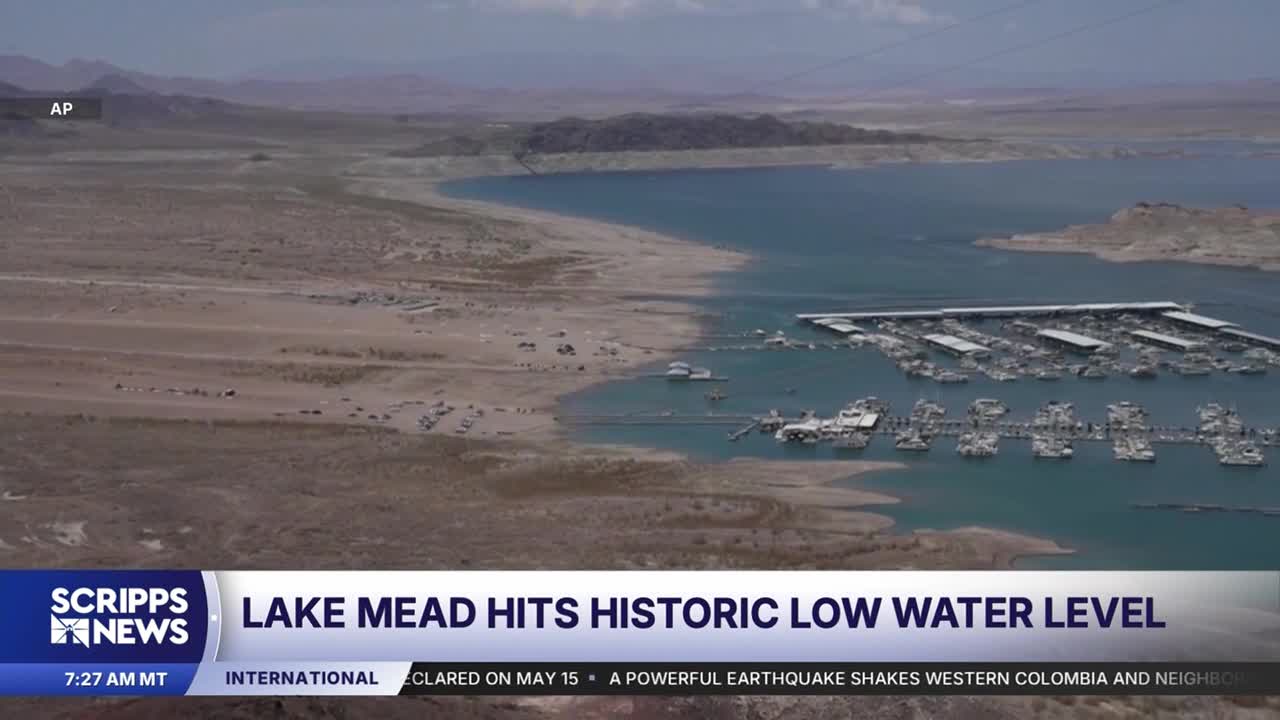


Lake Mead has hit a new record low water level, renewing concerns about the Colorado River Basin that serves roughly 40 million people across the American West.
The Bureau of Reclamation, which has tracked lake levels since the nation's largest reservoir was originally filled in the 1930s, recorded Lake Mead at 1,040.46 feet last week, breaking the previous record low of 1,040.5 feet set on July 28, 2022. The agency tracks water levels hourly and posts them on its website.
FROM THE ARCHIVES | Divers Find More Human Remains At Receding Lake Mead
Lake Powell, the nation's second largest reservoir, is also nearing a record low. As of last week, Lake Powell sat at 3,521.43 feet, approaching its previous record low of 3,519.92 feet, set in April 2023.
Water levels at Lake Mead had risen for a couple of years after 2022 following several wet winters, but Bureau of Reclamation data shows the lake's elevation has fallen every day since July 31 of this year.
Aquifer reserves shrinking
Because of water demands on the Colorado River Basin, some cities have been drawing groundwater from aquifers. According to NASA estimates, those reserves have lost 13.7 trillion gallons of water since 2002.
Federal proposal sets framework through 2036
Last Friday, the federal government released a new proposal that will provide the framework for future operating guidelines for the Colorado River. Federal authorities have suggested cutting about 3 million acre-feet of water, including about 300,000 acre-feet in Nevada — equivalent to enough water to fill just over 150,000 Olympic-size swimming pools.
Interior Secretary Doug Burgum said the proposal is designed to keep the river system stable for those who depend on it.
"The Department has a responsibility to ensure the Colorado River system remains reliable and resilient for the millions of Americans, communities, and industries that depend on it," Burgum said. "This framework provides the flexibility to respond to changing hydrologic conditions while preserving the opportunity for Basin States to continue working toward durable, consensus-based solutions."
RELATED STORY | Record snow drought in Western US raises concern for a spring of water shortages and wildfires
According to the Department of the Interior, the proposal includes key thresholds and ranges for operational elements and a process that will govern development and issuance of operating guidelines through 2036. Operational guidelines were chosen to ensure the Department would have flexibility and environmental compliance to operate the system in a way that is responsive to actual hydrologic conditions and allows for the incorporation of basin-wide innovative water management solutions.
Some states have also looked at possible alternatives, including desalination plants to convert seawater into fresh water.
Southern Nevada water cuts expected in 2027 and 2028
Bronson Mack with the Southern Nevada Water Authority previously told Scripps News that Southern Nevadans likely would not notice a major change.
"What this means for us here in Southern Nevada is that our water allocation is going to be reduced in 2027 and in 2028," Mack said. "But the good news is that our community has been so diligent in water conservation that our water use is below 200,000 acre-feet."
This story was originally published by Jarah Wright with the Scripps News Group in Las Vegas.
