

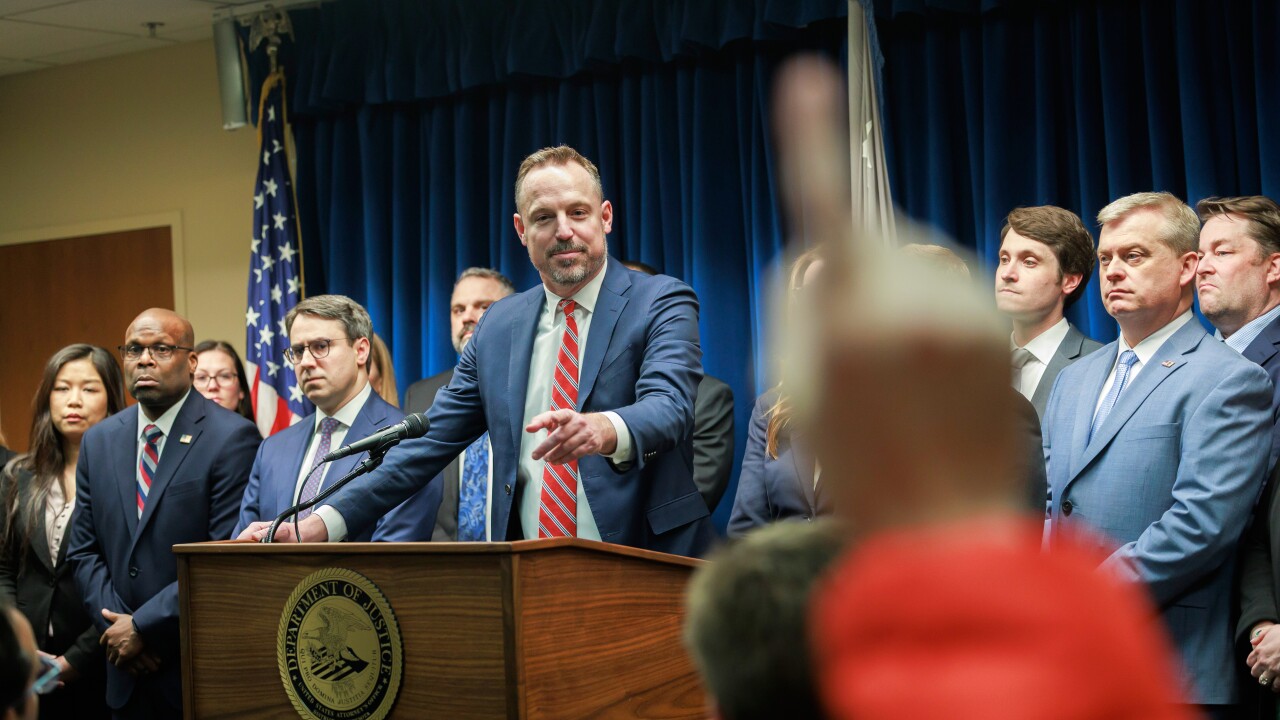


The federal prosecutor’s office in Minnesota has been gutted by a wave of career officials resigning or retiring over objections to Trump administration directives. Because of the turmoil, 12-time convicted felon Cory Allen McKay caught a break.
With a three-decade record of violent crime that includes strangling a pregnant woman and firing a shotgun under a person's chin, McKay was scheduled to stand trial next month on methamphetamine trafficking charges that could have locked him up for 25 years. Instead, he walked free after the prosecutor on his case retired.
The Trump administration says its aggressive immigration enforcement in Minnesota has improved public safety. Left in its wake, though, is a greatly weakened U.S. Attorney’s Office, where many prosecutors resented the way President Donald Trump’s political appointees at the Justice Department managed them.
RELATED STORY | 'This job sucks': Minnesota prosecutor resignations mount amid immigration case overload
Offices in other states, from New York to Virginia, have also been hit by resignations as prosecutors object to what they see as the politicization of decision-making under Trump. But Minnesota has been hit especially hard.
A growing number of defendants like McKay are beginning to escape accountability, as the remaining prosecutors are forced to dismiss some cases, kill others before charges are filed and seek plea agreements and delays.
Local officials worry the office will be unable, at least temporarily, to bring charges against some of the state’s most serious offenders.
“The result will be a diminished ability to target dangerous fraudsters, sexual predators, violent gangs and drug traffickers,” said John Marti, a Minneapolis lawyer who was a longtime fraud prosecutor in the office until 2015.
After asking for a delay to find someone to take McKay’s case, the office led by Trump appointee Daniel Rosen dropped it so abruptly McKay's lawyer didn’t learn about the move until after her client had been released.
“This was completely surprising to me,” said McKay’s lawyer, Jean Brandl. While she hasn’t been able to reach him, “I can guarantee you he’s happy about it.”
An exodus of prosecutors
Over the past year, the number of assistant U.S. attorneys in Minnesota has fallen from more than 40 prosecutors before Trump retook office to fewer than two dozen. That's according to a former federal prosecutor who wasn’t authorized to discuss personnel matters and spoke to The Associated Press on condition of anonymity.
The exodus began last year as several prosecutors “saw the writing on the wall” that their jobs — and the government’s definition of justice — were going to be different under the new administration, the former federal prosecutor said.
RELATED STORY | After Minneapolis shooting, Pretti family turns to lawyer from George Floyd case
It accelerated after Trump appointees in the Justice Department intervened to block a joint state-federal investigation into the Jan. 7 fatal shooting of Renee Good by U.S. Immigration and Customs Enforcement officer Jonathan Ross. While Trump officials called Good a “domestic terrorist” and argued Ross fired in self-defense, some in the office viewed the killing as a potential murder.
Career prosecutors also objected to directives that they divert much of their resources to immigration cases, and they chafed at repeated violations of court orders by ICE that angered judges.
“They could not in good conscience participate in what they have seen,” according to a letter released last week by eight former permanent or acting U.S. attorneys in Minnesota.
Among the many who left last month were the office’s former acting leader, Joe Thompson, and its criminal division chief Harry Jacobs. Thompson was a Justice Department veteran known for high-profile fraud investigations. He and Jacobs had helped uncover the $300 million Feeding Our Future scheme in which more than 75 defendants have been charged with defrauding a COVID-19-era child nutrition program.
Each time an experienced attorney leaves, leaders assess that prosecutor’s caseload and make decisions about how many of their cases can be reassigned to remaining staff and which will be dropped due to diminished resources.
Court records show the office has been operating in crisis mode, bringing in prosecutors from other states, asking judges to delay hearings, and trying to make some cases go away through dismissals and plea agreements. Defense lawyers are seeking to capitalize by demanding speedy trials for clients and filing other motions that require responses from prosecutors.
The Justice Department and the U.S. Attorney’s Office did not respond to requests for comment. The office's former spokesperson, prosecutor Melinda Williams, was among those who left.
Drug trafficking cases dismissed
McKay, 47, isn’t the only drug trafficking defendant to benefit.
The office last month also dropped a case against a man who was arrested in September after investigators said they found him in possession of a stash of drugs set to be trafficked in the Twin Cities that included 7,600 fentanyl pills and 15 pounds of cocaine.
A third dismissed case involved a man who was charged with conspiracy to distribute methamphetamine after police in Rochester found three pounds of the drug in a search of his vehicle in January 2025.
“With everybody leaving there, it’s presenting some challenges for everyone around the state,” said Clay County Sheriff Mark Empting, who said McKay would present “a big public safety concern” if he returns to Moorhead. “Hopefully they are going to rebuild the office and take these cases on again.”
10 pounds of highly pure meth
The case against McKay dated to 2024, when FedEx employees in Fargo, North Dakota, discovered a package containing nearly 10 pounds of highly pure meth arriving from California and addressed to McKay. Police estimated the street value at $80,000.
A detective posing as a FedEx employee delivered the package to McKay, who was arrested. Investigators say they searched cellphones, and found text messages linking McKay to other suspected drug traffickers in Minnesota, California, Chicago and Mexico.
McKay was jailed for nearly a year awaiting trial on state charges, before a federal grand jury returned an indictment in May 2025 charging him with two methamphetamine distribution charges. The indictment included a sentencing enhancement because he had more than two prior violent felonies.
Those include aggravated assault in 2013, domestic assault by strangulation in 2017 and assault causing substantial bodily harm in 2021. Prosecutors said he had at least a dozen felony convictions, dating to when he was 16 and fired a short-barreled shotgun under the chin of a victim.
An offender jailed, then set free
Longtime assistant U.S. Attorney Thomas Hollenhorst argued last summer that McKay was too dangerous to be released before trial, even to a substance abuse program, saying his history of violence would “put countless people at risk.”
RELATED STORY | More departures at the US attorney's office in Minnesota, AP sources say
A judge agreed, noting McKay had repeatedly failed to show up for court proceedings, given police false names and had his probation revoked for violations.
But last month, the U.S. Attorney’s Office noted that Hollenhorst was “retiring unexpectedly” and asked for a delay. A judge moved the trial date from Feb. 12 to March 2. The office still dropped the case days later in a filing that offered no explanation. A judge ordered McKay’s immediate release. Hollenhorst declined comment.
On Jan. 31, McKay walked out of the Sherburne County Jail in Elk River, 30 miles outside Minneapolis. Attempts by AP to reach him were unsuccessful.
Brandl, McKay's lawyer, said that while the outcome was a victory for her client, Hollenhorst’s retirement after 40 years with the Justice Department was “a huge loss.”
“He was a very good prosecutor,” she said. “He was reasonable and saw our clients as human beings, not just numbers.”
