


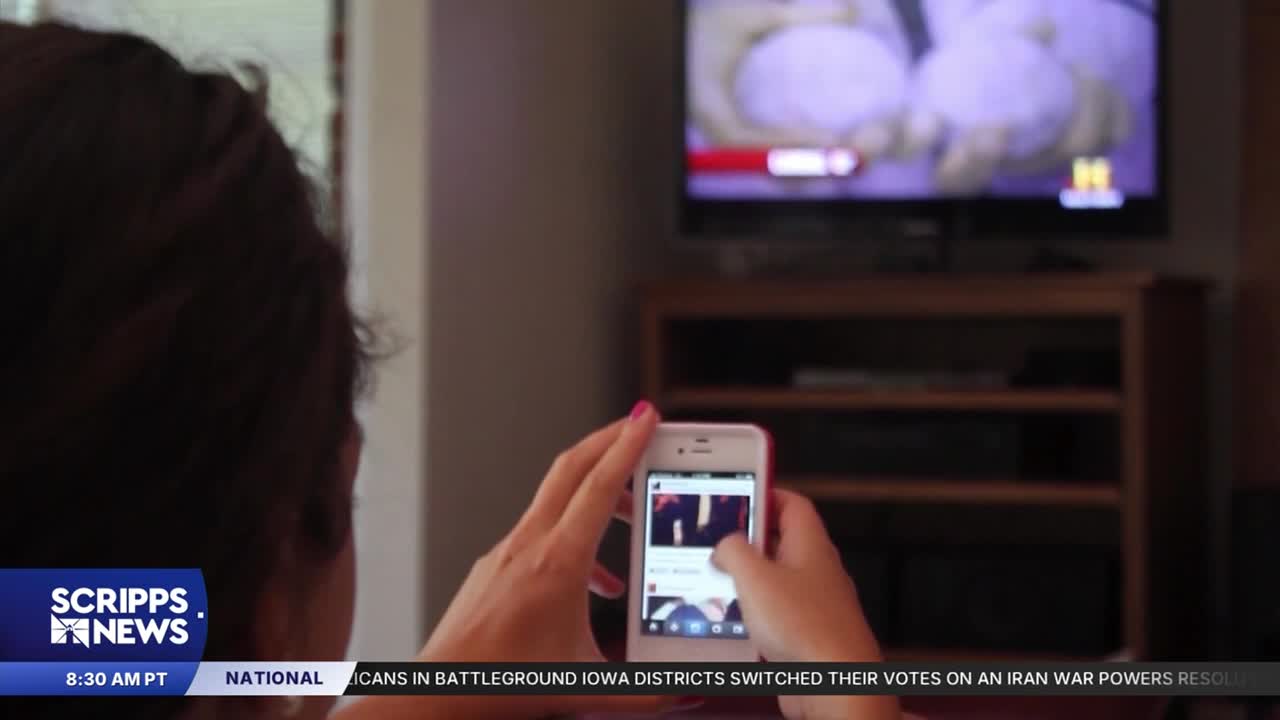


The European Union is moving to ban social media for children under 13 across the bloc and impose restrictions on the digital technology for older children, European Commission President Ursula von der Leyen announced Wednesday.
The move to develop EU-wide rules comes after several individual EU member states have introduced social media limits on teenagers amid a global push to restrict children’s access to social media. Australia became the first country in the world to ban social media for under 16s in December 2025.
“No social media under the age of 13. No personal account under the age of 15,” Von der Leyen said during her state of the union address in Strasbourg, France.
The EU would allow 13- and 14-year olds to have “mini accounts” with parental supervision and limited features, she added. The use of such accounts would be capped at one hour per day.
RELATED STORY | UK slaps social media ban on children under 16, including TikTok and YouTube
Most major social media platforms already say they ban children under the age of 13, but lawmakers and online safety experts have questioned whether they have adequate measures in place to enforce that rule.
The European Commission, the EU’s executive arm, would on Thursday propose a new Kids Act, Von der Leyen said. Under the act, the bloc would reverse the burden of proof, such that social media platforms would have to prove that they are safe for minors.
“I am aware that many perceive the power of big tech as overwhelming and impossible to roll back. I disagree,” Von der Leyen said. “Europe has the power to act. It is us who decide the rules, not Big Tech.”
In reality, the Kids Act could take years to cross the line, as it will need to be approved by individual EU member states, several of which have already pushed ahead with their own social media bans.
France became the first EU country to ban social media for children under the age of 15, following a vote by French lawmakers in July. The ban was later struck down by the country’s Constitutional Court, however. Spain, Denmark and Sweden are among other EU countries pursuing age restrictions on social media use.
RELATED STORY | Canada proposes ban on social media accounts for kids under 16 without safety proof
Lauro Fava a partner at law firm Pinsent Masons said the EU Kids Act would “be a new EU behemoth” comparable to the existing Digital Services Act, which regulates large online platforms, and the AI Act.
“For affected companies, they will be able to comply with a single, coherent, and potentially more balanced rulebook than if they had to deal with a multitude of member state laws,” he wrote in a commentary Tuesday after the EU-wide online safety measures were trailed in media reports.
On AI, Von der Leyen said she was optimistic that artificial intelligence had the potential to “benefit humanity if we get it right.”
RELATED STORY | Meta reaches $17 billion settlement with states in teen social media addiction case
However, “massive risks” associated with the technology – including “hacking on a level we never thought possible,” needed to be addressed in order to unlock the technology’s potential, she added.
Von der Leyen said she would invite the leading AI labs for talks on how the European Union can support the industry’s efforts to slow down the technology’s development – something the heads of Anthropic, OpenAI and xAI have all called for in recent days.
The-CNN-Wire
™ & © 2026 Cable News Network, Inc., a Warner Bros. Discovery Company. All rights reserved.
