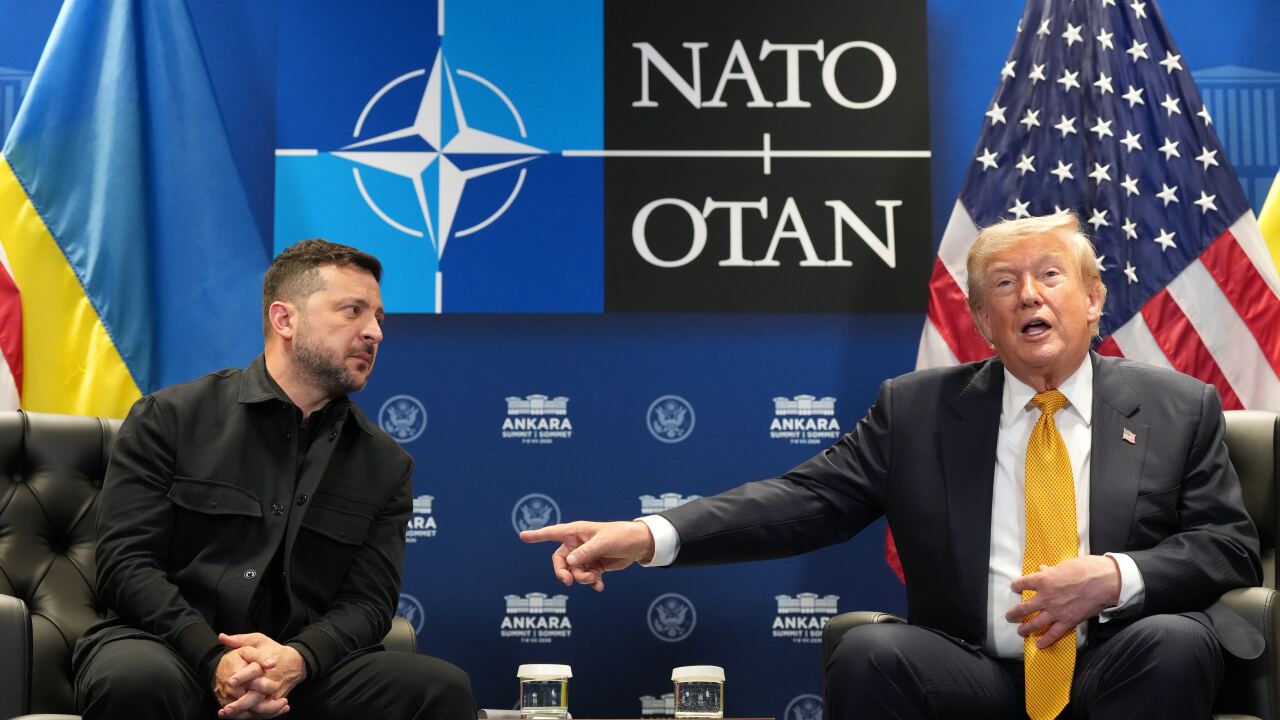


The Trump administration is touting NATO allies’ progress in defense spending following the leader’s summit in Ankara, as allies’ look to boost support for Ukraine, and the US resumes attacks against Iran.
“It’s a process and we need to make sure that this first year of success continues now as our allies become more capable and spend more money on their own defense, and therefore make NATO stronger collectively,” said Ambassador Matthew Whitaker, the permanent representative of the US to NATO.
The summit came as the US works to shift the defense burden to Europe.
“We're in the middle of a transition to a European-led NATO, a NATO that provides security here in Europe that is primarily provided by Europeans. It's the right thing to do. It's a good balance, and it frees the United States up, as you know, to address the global issues that the United States uniquely faces. And so, it's a win-win for the alliance. It's a win for the United States and the taxpayers that have spent way too much money,” Whitaker said.
During the summit, President Trump suggested the US would approve licenses for production of Patriot air defense missiles to help Ukraine, which is continuing to face attacks from Russia as it strikes deeper into Russian territory in response. Whitaker said he will be continuing the conversations as industry and the Pentagon also coordinate on the effort.
RELATED STORY | Ukraine gets a Patriot license from Trump, but the missiles it needs most are years away
“I'm working together with many people in the administration and in industry to effectuate the president's intent on that. But you know, there's a lot of work to do when you're dealing with licenses and manufacturing overseas, and so we're going to take it a step at a time,” Whitaker said. “The president was very clear about what he wanted, and we're all moving out as fast as we can to make sure that we address the commander's intent.”
However, Whitaker did not provide a timeline.
“Two things are true. One is that Ukraine needs more air defense, and the United States has unique systems that only we can produce and provide right now. And second is that Ukraine has a significant defense industry and industrial base, but to prop up a new manufacturing or assembly line in a war country is going to take some time. So it's certainly not going to be months, but we're going to move as quickly as we possibly can to make sure that what the president said at the summit becomes a reality,” he said.
NATO allies called for Iran to respect freedom of navigation in the Strait of Hormuz during the summit. During that time the US resumed attacks against Iran in response to Iranian aggression in the Strait of Hormuz and Tuesday US Central Command reinstated a naval blockade against Iran.
Whitaker said NATO allies are coordinating with Central Command, noting some were already moving assets to the region.
“The biggest challenge that we face here in NATO is that a lot of our allies didn't have capabilities that we could use in the region, or that their capabilities weren't ready to move out. So, you know, we are getting very positive response. You know, the president heard it at the table in the summit. We are, you know, we had seen it before the summit. We are certainly seeing it now after the summit of allies raising their hand, wanting to contribute and doing it so in an organized manner, but obviously the United States has some pretty extraordinary capabilities already in the region, and we're going to address you know any threats to our troops, to you know to commerce in the Strait, and you know we're going to continue to come from a position of strength, and you know that's what President Trump does best,” Whitaker said.
RELATED STORY | Ukraine, 9 others announce coalition to protect Europe from ballistic missiles
However, Whitaker did not say whether the US was accepting.
“You know we're coordinating with all of our allies. Obviously, Europe has a tremendous number of mine-sweeping capacity and capabilities that we are coordinating with. They have other demining opportunities. They have frigates. They have aircraft carriers, and so you know we are coordinating,” he said.
While Whitaker acknowledged some allies “would prefer a more permissive environment” in the Strait, he noted “this is certainly never going to be a permissive environment in the near term.”
In recent days, Iran has launched attacks at commercial shipping vessels, the US has resumed strikes on Iranian military targets and Iran has launched strikes at Middle Eastern countries.
“We’re responding with overwhelming force. You know if they hit a ship in commerce transiting the Strait, you know we have responded with 10s, if not a 100 hits on military targets in response, and you know we are pounding them, and they're going to realize that the diplomacy and peace is the better path. And you know sometimes that lesson I guess needs to be a reminder to the Iranians that they should come back to the table and continue to negotiate a deal that makes sense,” Whitaker said. “President Trump's been very clear that the object of this mission is to denuclearize Iran; that they cannot have a nuclear weapon, and we're going to keep moving to that end. And he's a peacemaker, he wants to negotiate, and you know, but if he needs to, he's going to also use the awesome might of the American military.”
IN CASE YOU MISSED IT | Trump drops planned Strait of Hormuz toll in favor of Gulf trade deals
Monday, President Trump said the US would seek a 20 percent reimbursement fee for providing security in the Strait of Hormuz, despite the administration’s rejection of Iranian efforts to collect tolls, citing freedom of navigation. Tuesday, he reversed course and announced he would pursue trade and investment deals instead after conversations with Middle Eastern leaders he said wanted to invest in the US.
Before the update from the President, Whitaker said he was not concerned the fee could alienate NATO allies.
“I’m not concerned about that. Obviously, the President is making the decisions, and he has decided that this is an appropriate for the situation. But you know, we are going to continue to push for a deal with the Iranians. This, you know, the the table is still open to negotiate, and I know that at least as of recently, the technical people were still talking about some of the very precise issues that are involved in this deal,” he said.