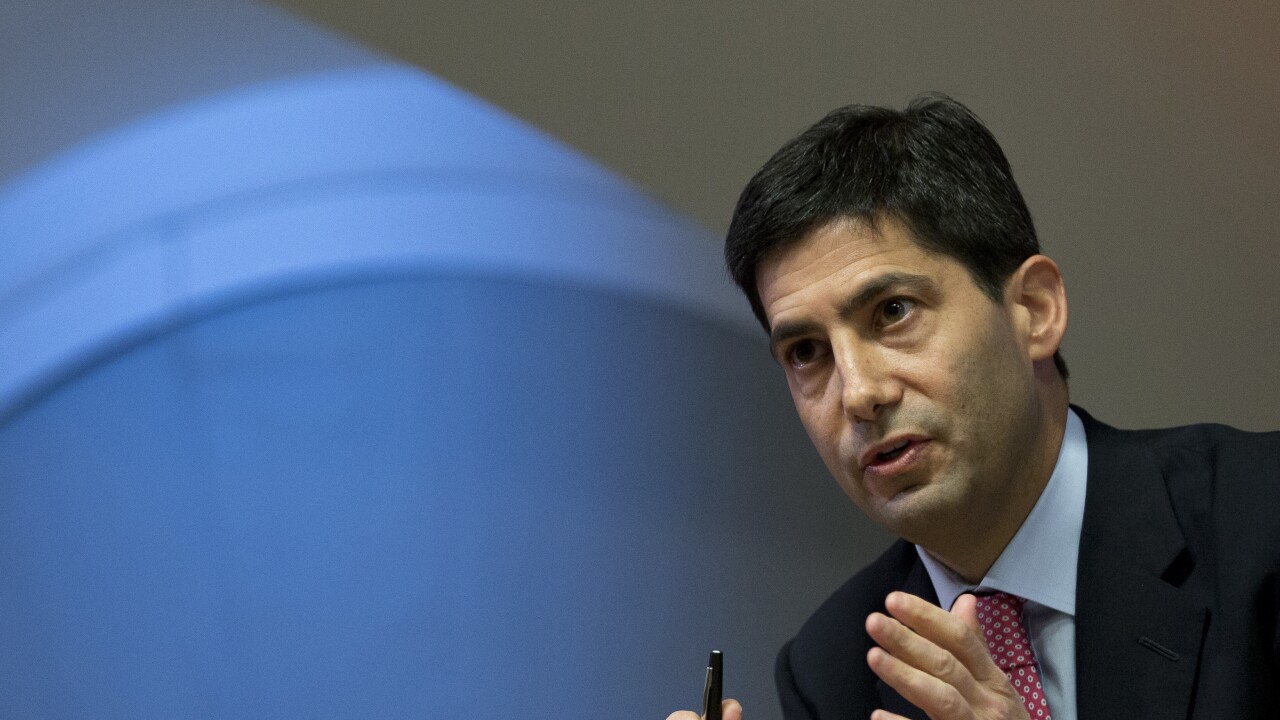


President Donald Trump announced early Friday that he intends to nominate Kevin Warsh as the next chair of the Federal Reserve, replacing Jerome Powell. The nomination follows Trump’s repeated criticism of Powell for not lowering interest rates as much as the president has wanted.
Warsh previously served on the Federal Reserve Board from 2006 to 2011, a tenure that coincided with the most significant U.S. recession in decades.
"I have known Kevin for a long period of time, and have no doubt that he will go down as one of the GREAT Fed Chairmen, maybe the best. On top of everything else, he is 'central casting,' and he will never let you down," Trump wrote on Truth Social.
RELATED STORY | Federal Reserve keeps interest rates unchanged even as Trump continues to insist they be lowered
Despite Trump’s threats to fire Powell, it appears Powell will remain Fed chair through May 2026. He can remain on the board as a governor until 2028. The president’s authority to remove Federal Reserve members has been questioned after federal courts blocked Trump from removing board member Lisa Cook.
Nomination Already Facing Resistance
Warsh’s nomination will require a simple majority of the Senate. Republicans hold 53 seats, but some members have signaled they may withhold support.
After the Justice Department opened an investigation into Powell for potential perjury charges, Sen. Thom Tillis, R-N.C., accused Trump of undermining the Fed’s independence.
"If there were any remaining doubt whether advisers within the Trump Administration are actively pushing to end the independence of the Federal Reserve, there should now be none. It is now the independence and credibility of the Department of Justice that are in question," he said. “I will oppose the confirmation of any nominee for the Fed—including the upcoming Fed Chair vacancy—until this legal matter is fully resolved.”
Sen. Lisa Murkowski, R-Alaska, also said she would not support moving forward with a nomination at this time.
RELATED STORY | Fed cuts interest rate for third time this year, signals only one cut in 2026
"The stakes are too high to look the other way: if the Federal Reserve loses its independence, the stability of our markets and the broader economy will suffer. My colleague, Senator Tillis, is right in blocking any Federal Reserve nominees until this is resolved," she said.
Role of the Federal Reserve
The Federal Reserve’s most important function is setting the federal funds rate, which influences the interest rates banks charge each other for overnight loans. This indirectly affects consumer lending rates for mortgages, auto loans and credit cards, as well as borrowing costs for businesses.
Low interest rates generally spur economic growth by making borrowing cheaper. However, Fed policymakers argue that keeping rates too low for too long can fuel inflation.
After U.S. inflation topped 9% in 2022, the Fed raised rates to their highest level in decades. Inflation has since dropped to under 3%, but the higher borrowing costs have made it harder for consumers and businesses to access credit. This trade-off often slows job growth. Powell has said the Fed’s goal is to balance low inflation with continued job gains.
About Kevin Warsh
Warsh was appointed to the Federal Reserve Board in 2006 by President George W. Bush. During the 2008 global financial crisis, he served as the board’s liaison to Wall Street as the Fed implemented emergency liquidity programs to aid banks struggling with subprime mortgage losses.
Before joining the Fed, Warsh was an economic adviser to Bush and executive secretary of the National Economic Council.
More recently, he has served as a distinguished visiting fellow at Stanford University’s Hoover Institution and has been an outspoken critic of Powell’s leadership at the Fed.
“We need regime change in the conduct of policy,” Warsh said during a July 17, 2025, interview on CNBC’s “Squawk Box.” “The credibility deficit lies with the incumbents that are at the Fed, in my view.”
He echoed Trump's view that the Federal Reserve was too slow with rolling out interest rate cuts.
“Their hesitancy to cut rates, I think, is actually ... quite a mark against them,” Warsh told CNBC. “The specter of the miss they made on inflation, it has stuck with them. So one of the reasons why the president, I think, is right to be pushing the Fed publicly is we need regime change in the conduct of policy.”