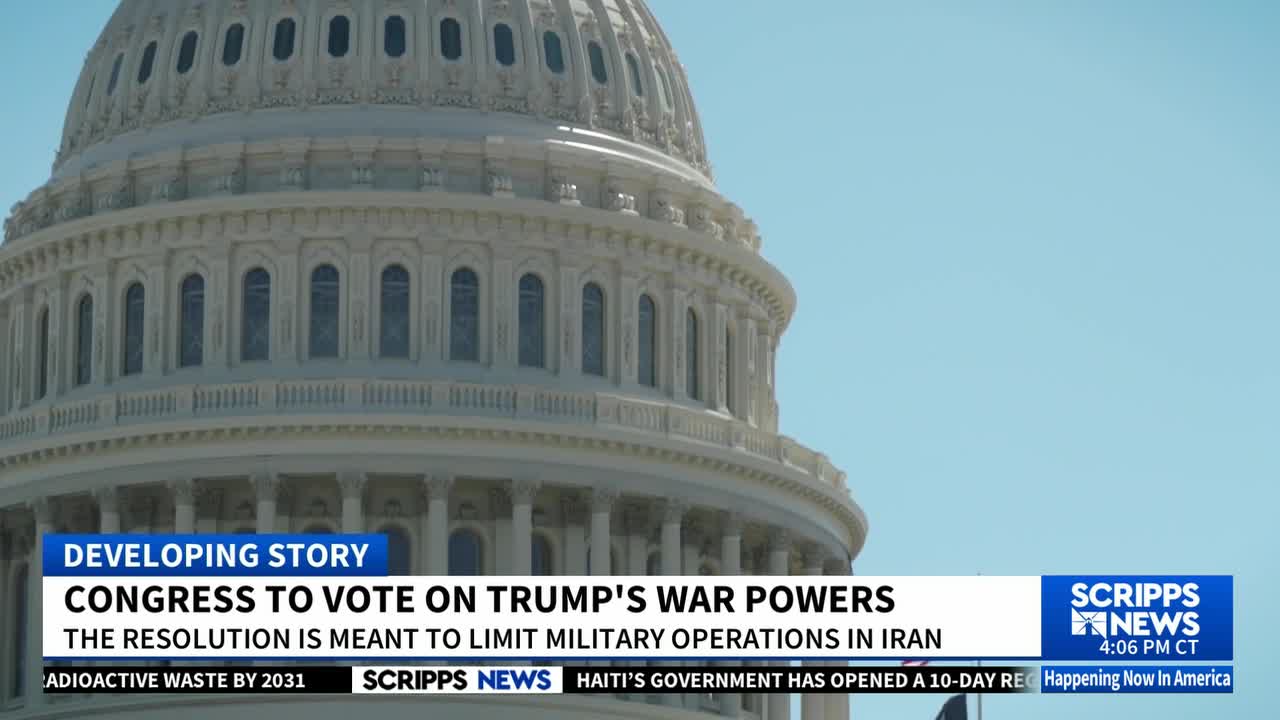


Democratic lawmakers are seeking a vote on a war powers resolution in the Senate to try to limit President Donald Trump's ability to unilaterally commit the U.S. to war in Iran.
The U.S. Constitution requires that Congress oversees declarations of war, and that the president seeks congressional approval for war activities. If Congress has not declared war, the War Powers Act requires that the executive branch brief members of Congress within 48 hours of a war deployment. That use of the armed forces must end 60 days later, unless Congress authorizes its continuation.
While some Republicans are joining the effort to rein in the president, many of the party have defended President Trump's decision to make initial strikes.
Secretary of State Marco Rubio said Monday he believed because of an imminent attack by Israel on Iran, the U.S. was under pressure to commit to those supporting strikes.
Rubio on Monday briefed members of the Gang of Eight, which receives classified intelligence information from the White House and includes heads of both the Democratic and Republican parties in the House and Senate.
That briefing is believed to be the first time congressional leaders had the opportunity to meet with Rubio and get a full accounting understanding for why the Trump administration took the action it did.
RELATED NEWS | 6 US service members killed as Iran conflict intensifies
"To me, the most critical point is that this was a defensive measure, a defensive operation," House Speaker Mike Johnson told reporters following the briefing. "Israel was determined to act in their own defense here, with or without American support. Why? Because Israel faced what they deem to be an existential threat. Iran was building missiles at a radical and a rapid clip, to the point where our allies in the region could not keep up."
"As you know, Iran has long vowed to take out Israel, wipe it off the map. And they have long seen that as a a critical threat to their very existence. Because Israel was determined to act with or without the U.S., our commander in chief and the administration and the officials I just named had a very difficult decision to make. They had to evaluate the threats to the U.S., to our troops, to our installations, to our assets in the region and beyond. And they determined because of the exquisite intelligence that we had, that if Israel fired upon Iran and took action against Iran to take out the missiles, then they would have immediately retaliated against U.S. personnel and assets. We have troops in harm's way and we have many Americans in the region and that was of great concern. If we had waited for all of those eventualities to take place, the consequences of inaction on our part, would have been, could have been devastating."