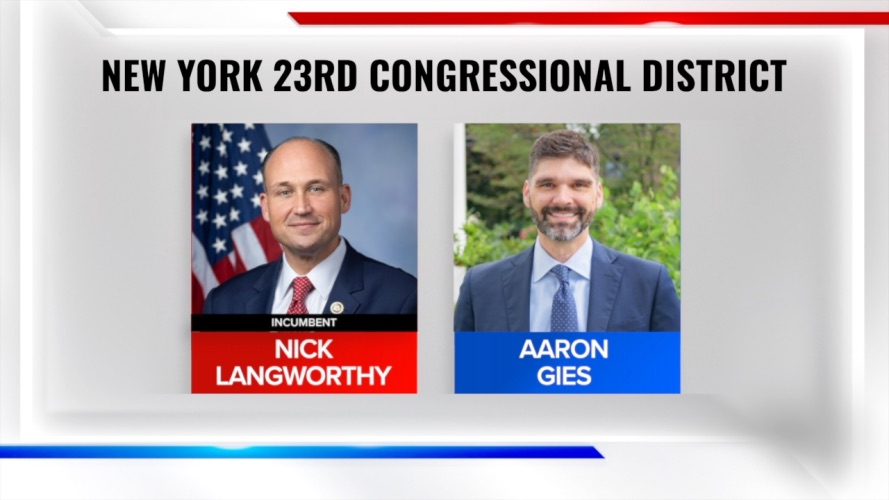


BUFFALO, N.Y. (WKBW) — Republican Rep. Nick Langworthy and Democratic challenger Aaron Gies are facing off in their first and only televised debate of the 23rd Congressional District campaign Tuesday night, but most voters in the district won't be able to watch it on television.
The debate is being hosted by Elmira television station WETM-TV. That's significant because about 72% of voters in the 23rd Congressional District are located in the Buffalo television market, where the debate will only be available via web stream.
Gies has agreed to additional televised debates. He has accused Langworthy of backing away from an earlier commitment to participate in more debates.
WATCH: Langworthy, Gies face off in only televised debate, but Buffalo-area voters won't see it on TV
The issue dates back to this summer, when Gies confronted Langworthy at the Eden Corn Festival.
Gies asked Langworthy whether he would be open to participating in additional debates.
"I'll do any debates if the media suggests," Langworthy responded in the video posted by the Gies campaign.
The two candidates agreed to the debate hosted by WETM, which also hosted Langworthy and his Democratic opponent in the 2024 election. When 7 News contacted both campaigns last week about a potential Buffalo-area debate, Gies agreed. Langworthy's campaign did not, saying the congressman planned to participate in two debates: the WETM debate and one hosted by WBEN.
As of Monday, however, WBEN said it had not issued a formal invitation for a debate, according to an email provided by the Gies campaign.
Gies has continued to criticize Langworthy on social media, accusing the incumbent of avoiding accountability by limiting the number of debates.
Do voters actually care about debates?
Two local political science professors said there are potential risks and rewards for both candidates.
Dr. Jacob Neiheisel, an associate professor of political science at the University at Buffalo, said voters generally support the idea of seeing candidates debate, but that doesn't necessarily mean debates determine how they vote.
"In the abstract, it sounds like a great idea. Yes, we should have debates, absolutely," Neiheisel said. "Is it something that's going to determine my vote or whether I vote? Probably not."
That can make debates a particularly important strategic decision for an incumbent.
Dr. Shawn Donahue, a clinical associate professor of political science at the University at Buffalo, said Langworthy could face political criticism if voters perceive his decision to limit debates as an attempt to avoid engaging with constituents.
"Whenever you allow the challenger to be on the debate stage with you, that kind of has the effect of elevating them, kind of to your level in some ways," Donahue said.
At the same time, an incumbent who believes he has a strong advantage has an incentive to limit opportunities for a challenger to gain exposure.
Donahue said candidates are increasingly making that calculation.
"Different candidates are making the calculation that it's maybe not worth their time to do so," he said, "or that it might be to their political advantage ... to limit the number of debates that they have."
Langworthy has the advantage
Langworthy enters the final weeks of the campaign with a significant advantage.
A poll promoted by the Gies campaign showed the Democratic challenger trailing Langworthy by double digits.
That makes the national political environment particularly important for Gies, Neiheisel said. If Democrats dramatically outperform expectations in November, a national political wave could potentially make traditionally Republican districts more competitive, though that kind of upset remains unusual.
"We've seen that before," Neiheisel said. "It's rare, but with the Republican revolution in 1994, some seats that were (held by Democrats) that were thought to be basically untouchable, they flipped."
7 News is talking with the candidates
While voters in the Buffalo market will not see Tuesday night's debate on local television, both Langworthy and Gies have agreed to sit down separately with 7 News for in-depth interviews about the issues most important to voters.
7 News will have those interviews in the weeks ahead.
Election Day is November 3.