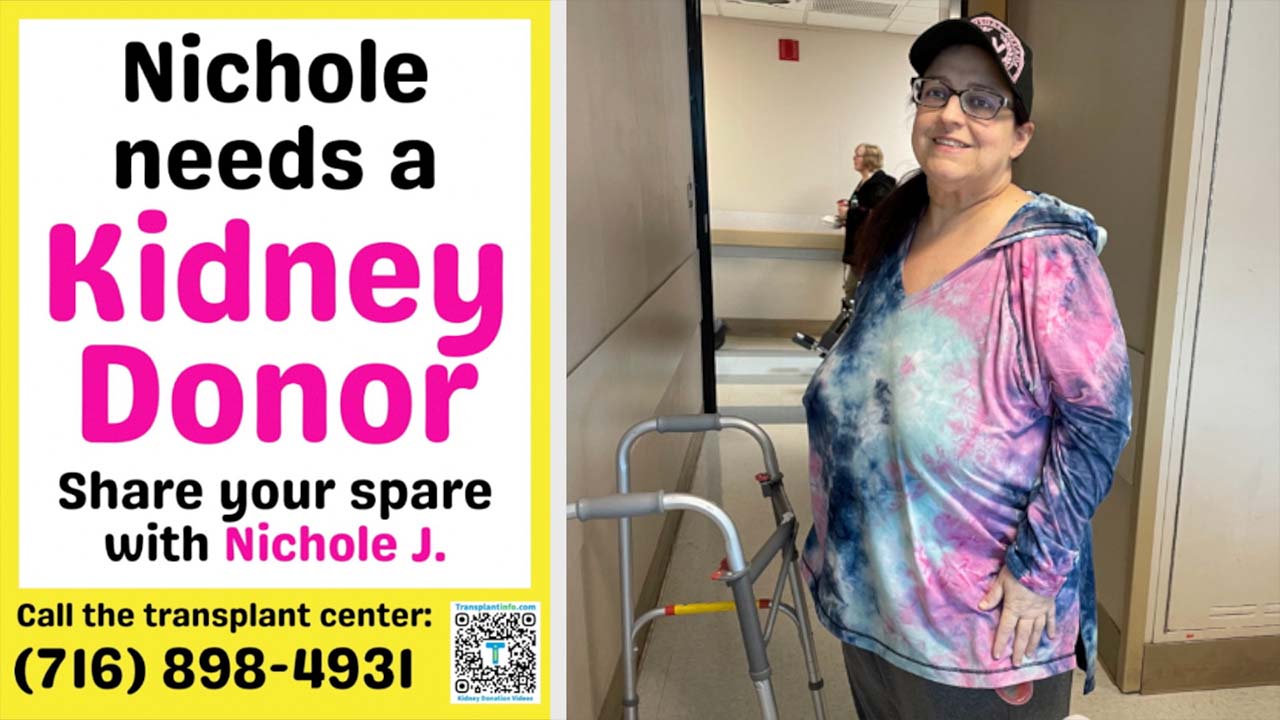


WEST SENECA, N.Y. (WKBW) — March is National Kidney Month, a time to raise awareness about kidney health and the urgent need for living donors.
As of September 2024, nearly 90,000 people were waiting for a kidney, according to the Health Resources and Services Administration. While a record 6,800 living donors donated a kidney in 2019, the waitlist remains extensive.
For patients like Nichole Jenson, finding a donor is a chance at a full life. Jenson has faced numerous health challenges since 2017, beginning with lipedema and lymphedema, a swelling disorder.
WATCH: West Seneca woman raising awareness for kidney donations while awaiting transplant
"In 2021, I ended up having sepsis, and I was hospitalized for 11 days in the ICU and then had to go into rehab, basically to relearn to walk and have lymphoedema therapy. And at that time, my kidneys almost went into full renal failure," Jenson said.
Jenson learned her kidneys were functioning at around 15 percent. Following the diagnosis, she shifted her lifestyle, lost 200 pounds, and focused on her health. She is now on the kidney transplant list and advocates for others on the same journey.

"That's probably the scariest part of it all, I've been through so many surgeries, and I can handle all that, but I think being on dialysis is the scariest thing for me," Jenson said.
Kidney disease is often described as the "silent killer" because symptoms rarely appear until the disease reaches advanced stages, making dialysis a necessity.

"When the kidney is starting to get scarred down and you don't have a 100 percent function, you go down to 90 percent, you don't notice it. You go down to 80 percent, you don't notice it, 70 percent, 60 percent, 50 percent, actually, you don't start noticing it until your kidney function is around 20 percent or less," Dr. Liise Kayler said.
Kayler is the division chief of transplantation at ECMC. She said that without functioning kidneys, people die within about three weeks.
"It eliminates toxins and fluids from your body. If you don't have something doing that, then the toxins and fluids build up," Kayler said.

Symptoms of kidney failure include puffy ankles, shortness of breath, itching, nausea, and vomiting. Because these mirror other illnesses, doctors emphasize the importance of regular checkups.
"They can see your kidney function very easily with a simple blood test; they can see it every year and see which direction it's trending and how good or good it is or not," Kayler said.
If a patient's kidney function trends in the wrong direction, they are referred to a specialist. Most people waiting for a transplant rely on dialysis to survive.

"It is a great treatment in terms of it keeps people alive, but it's hard on a person's body," Jeremy Morlock said. "It's hard on a person's mental health. Most people on dialysis are treated four hours a day, three days a week. It's exhausting."
Morlock, the director of the Kidney Foundation of Western New York, aims to raise awareness about the life-changing benefits of becoming a living donor.
"It's a pretty wonderful thing. If you want to be a kidney donor, the transplant center will do a really thorough medical workup to make sure that the person is able to undergo that surgery, that they're going to be able to function well long term with just one kidney," Morlock said.
For patients waiting on the list, the support of medical teams and potential donors makes all the difference.
"They're so supportive and they make the process supportive and they make the process just so much better, and I'm so thankful for all of them," Jenson said.
Becoming an organ donor requires extensive testing to ensure the donor's safety and the compatibility of the organ. Information on how to become a kidney donor is available here.
For patients on the waiting list, the support of medical teams and potential donors makes all the difference.

Join the Southtowns Community News Facebook group to connect with neighbors and learn about what's happening in your community.