

BUFFALO, N.Y. (WKBW) — If you looked at the latest U.S. News & World Report high school rankings and wondered what happened to some of Western New York's top-performing schools, you're not alone.
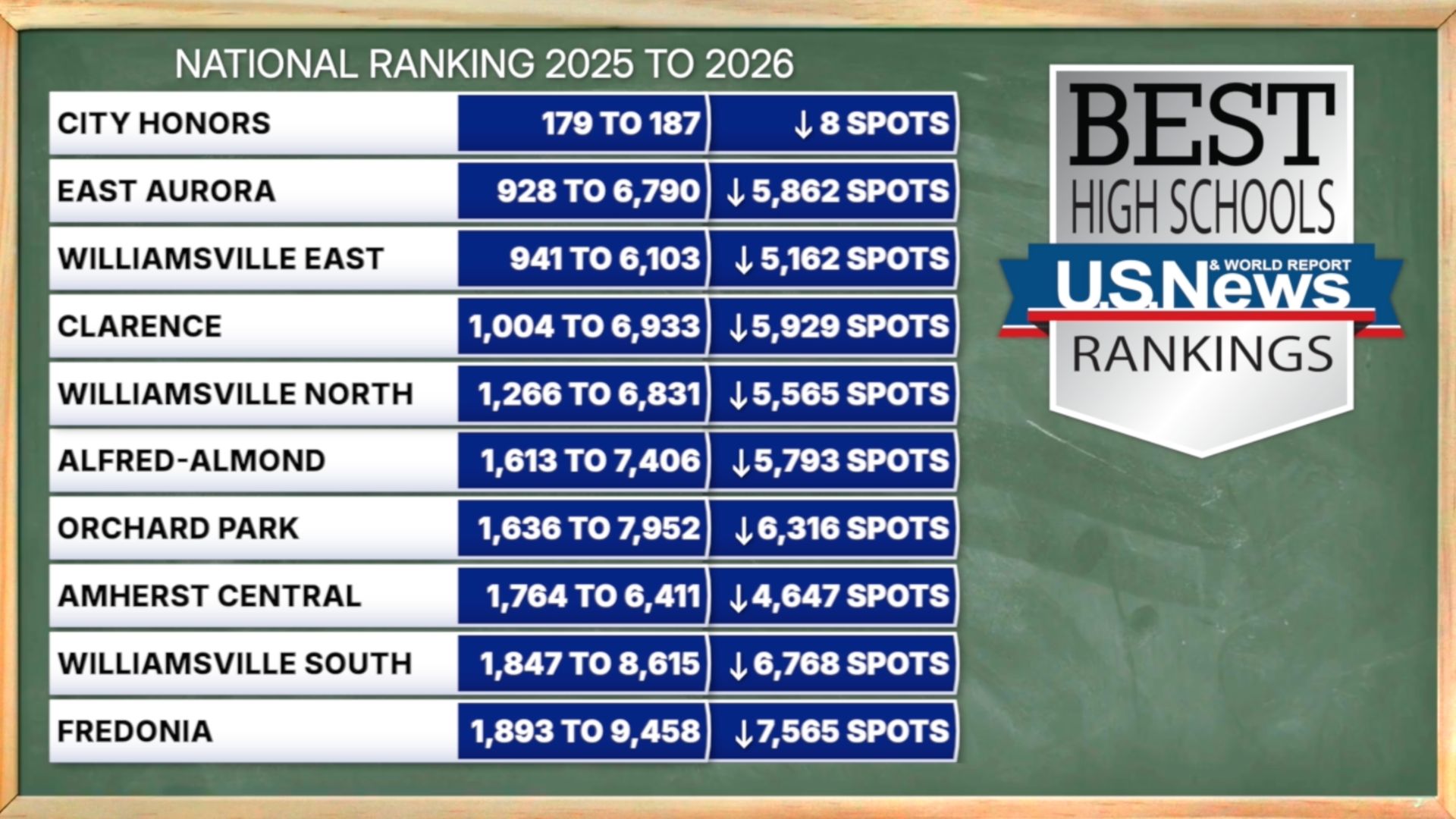
Nine of the ten schools that ranked highest in the region last year dropped dramatically in the latest report.
The reason has less to do with changes at the schools themselves and more to do with a change in the data used by U.S. News.
City Honors remains highest-ranked in WNY
Once again, City Honors School at Fosdick Masten Park in Buffalo is the highest-ranked high school in Western New York.
It is ranked No. 187 nationally and No. 2 in New York State in the 2026–27 U.S. News rankings.
But other high-performing schools in the region saw much more significant changes.
WATCH: Many Western New York high schools plunge in U.S. News rankings - Here's what changed
East Aurora High School, which ranked No. 928 nationally last year, dropped nearly 6,000 spots this year.
Williamsville East, Clarence and Williamsville North — along with other schools that ranked among the region's top schools last year — also saw dramatic declines.
Education policy expert Nat Malkus, deputy director of education policy studies at the American Enterprise Institute, said the U.S. News rankings have pluses and minuses.
"There's no perfect set of data to use to compare how good high schools are," Malkus said. "The benefit of these rankings is they're simple, and parents know where to get them. They know how to understand them, and so a lot of people depend on them, even if they're not perfect."
AP data missing from this year's rankings
The biggest change this year involves Advanced Placement, or AP, data.
New York State did not authorize the College Board to provide AP participation and performance information to U.S. News for this year's rankings, despite doing so in the past.
The New York State Education Department (NYSED) claims the decision was based on student privacy laws.
"Compliance with New York's student privacy laws is not optional, and it does not take a back seat to U.S. News & World Report's commercial ranking methodology, or any other desire to turn information about New York's children into a for-profit product," a NYSED spokesperson told 7 News.
Malkus is skeptical of the state's privacy argument.
"I don't buy it at all," Malkus said. "Look, I want them to make their clear case so I can understand exactly what I'm arguing about, but oftentimes, school districts and states will play the privacy card based on very slim threats to students' privacy, and it harms parents, researchers, policymakers' ability to cut through the noise and see how schools are performing. And at the end of the day, understanding school performance is very important, even as important as student privacy."
U.S. News disputes the state's explanation of what it requested.
"NYSED has characterized U.S. News' request as an attempt to obtain protected, individual student-level data," the media company said in a statement in early Sept. "This is categorically false. No individual student data was requested."
Malkus agreed with U.S. News.
"These aren't individual kids' scores," he explained. "They send, you know, headline numbers, top line numbers for a school, and New York is saying, well, we can't, we can't do that. Well, what they're really saying is we're not going to do that anymore. They've been providing that for years."
Why the rankings changed so dramatically
AP and International Baccalaureate participation and performance are part of the U.S. News methodology, which includes six factors for the 2026-27 rankings: state assessment proficiency, state assessment performance, underserved student performance, graduation rate, college readiness and college curriculum breadth. AP and IB data are used in the college-readiness and curriculum-breadth measures.
For New York schools, U.S. News used IB data for those measures because the AP data was not available.
That means schools with strong AP programs could receive less credit in the rankings than they did in previous years.
Other schools with robust IB programs were less affected.
City Honors offers a notable contrast
That helps explain why City Honors was not hit nearly as hard. The Buffalo public school has a robust International Baccalaureate program. Because IB data was available for the rankings, City Honors continued to receive credit for those advanced-course measures.
City Honors ranked No. 25 in New York last year and now ranks No. 2 statewide, while its national ranking moved only from No. 179 to No. 187.
What does a drop of thousands of spots actually mean?
Malkus says the rankings are significant because families pay attention to them, and schools often take pride in where they appear on the list. But he says the latest changes should be interpreted carefully.
"Well, you know, it is significant, and it's not significant," Malkus said. "Look, these measures are important. People look at them, they pay attention to them. Schools work towards them and take pride in them. And look, having a lot of kids taking and passing AP courses is a mark of high performance among students. Those are all good things. This is not super meaningful because I don't think that the fact that now the data is not available, so these schools drop in the rankings reflect that the schools are doing a worse job than they were last year. That also means the rankings aren't as informative as they may have once been."
The controversy has now gone beyond the rankings themselves.
Success Academy Charter Schools in New York City has filed a federal lawsuit against the state over the decision not to authorize the release of the AP data to U.S. News. The lawsuit alleges the state's action violates the First Amendment. Success Academy's ranking dropped from No. 11 in New York last year to No. 196 this year.
The issue is not limited to New York City. Schools across New York have seen significant ranking declines this year, with some districts specifically pointing to the missing AP data.