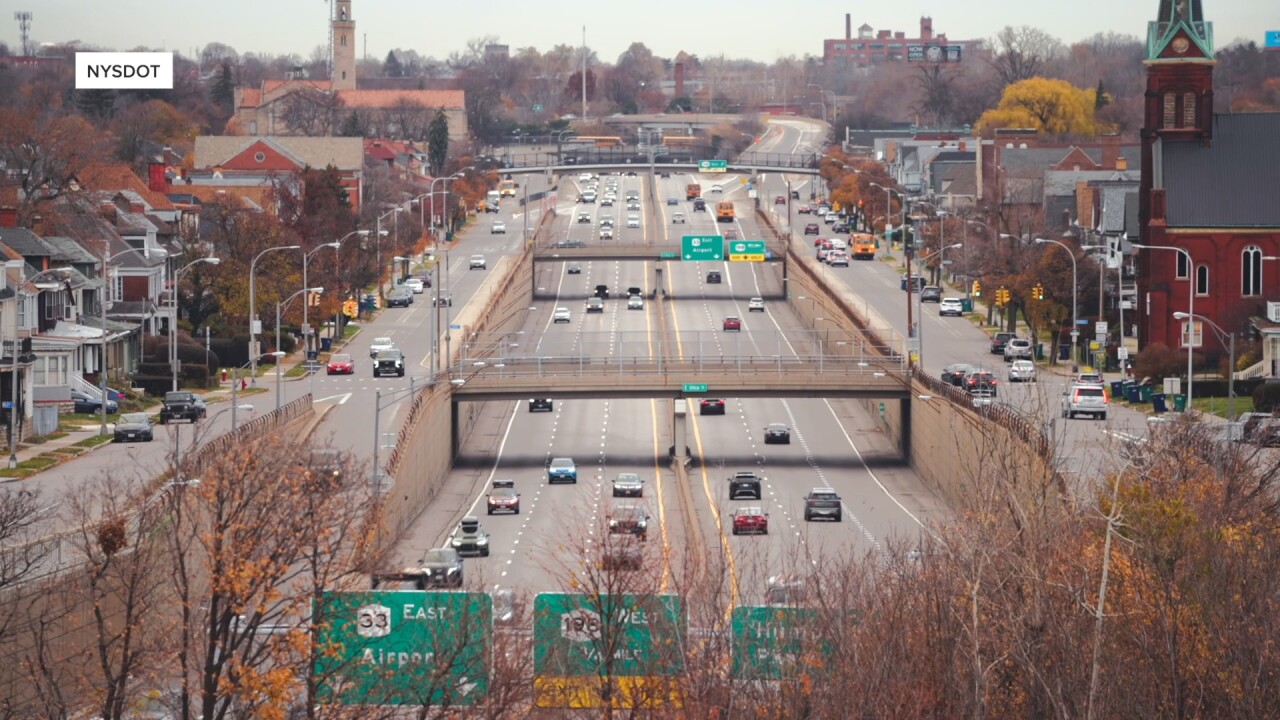


BUFFALO, N.Y. (WKBW) — The future of Buffalo's Kensington Expressway is now in the hands of the community.
The New York State Department of Transportation held its first listening session on Tuesday night, during which residents were asked what they would like to see replace the highway, commonly known as "The 33."
The state also unveiled a new website, QueenCityForward.dot.ny.gov, designed to gather public input on how to proceed with the expressway.
WATCH: Buffalo residents share vision for Kensington Expressway's future
The state previously wanted to cover a three-quarter-mile section by building a tunnel to reconnect the community that was split in two. But groups sued, and a judge found that a full environmental impact study is needed. Now it's back to square one.
I attended the first listening session at the Schiller Park Senior Center, hearing voices from those who will ultimately decide what happens moving forward.
The state DOT hosted the session, complete with visual aids, providing opportunities for public feedback and discussions with state representatives. Input gathered from Tuesday night's meeting will provide project leaders with feedback on potential ideas moving forward.
That includes studying the idea of a fill-in option and the diversion of 75,000 daily vehicles on the 33.
I spoke with several people about their concerns over the current state of the highway.

"Think of Delaware Park. Think of Central Park in New York City. It's an attraction worldwide. We have that in Buffalo," said Deborah Cohen, a Buffalo resident of 57 years. "That for generations and generations they can bring beauty, peace, tranquility, neighborliness, togetherness, to generations to come, but we need to restore it."

Lorena James, a Buffalonian who recently moved back to the city, emphasized the importance of public transportation and environmental considerations.
"I mean for sure the access to public transportation, I think is really important in Buffalo," James said. "So as we're dating this next solution for the Kensington Expressway, making sure that there is adequate public transport, and making sure that we're prioritizing clean air for our community and, coming from an environmental studies background, access to green spaces as well is really important."
"I grew up across the street from MLK Park on the East Side, so yes, having access to green space is really, really important."

Albert Chao, a Buffalo resident of 15 years, acknowledged the highway's negative impact while recognizing the community's resilience.
"Terrible thing. This highway is terrible, and yet it has emerged from this really terrible thing," Chao said. "It's like a community that has organized, has built political power, has done really beautiful things, and in that process has also developed a way to figure out how to pave a way for the future."

Another Buffalo resident says the neighborhoods being separated across the 33 hurt much more than meets the eye.
"Maintaining a trench that was created through blasting through bedrock, which can't be done today feasibly or affordably, really loses the opportunity for grade-separated public transit, or high-speed buses, and rapid light rail that could be potentially within a tunnel in the future," said Scott Archambault, a longtime Buffalo resident.

Future sessions will be held in areas where residents are affected by proximity to the expressway.
The next listening session will be held on Tuesday, Dec. 16, from 5 to 7 p.m. at the Edward Saunders Community Center, located at 2777 Bailey Avenue.