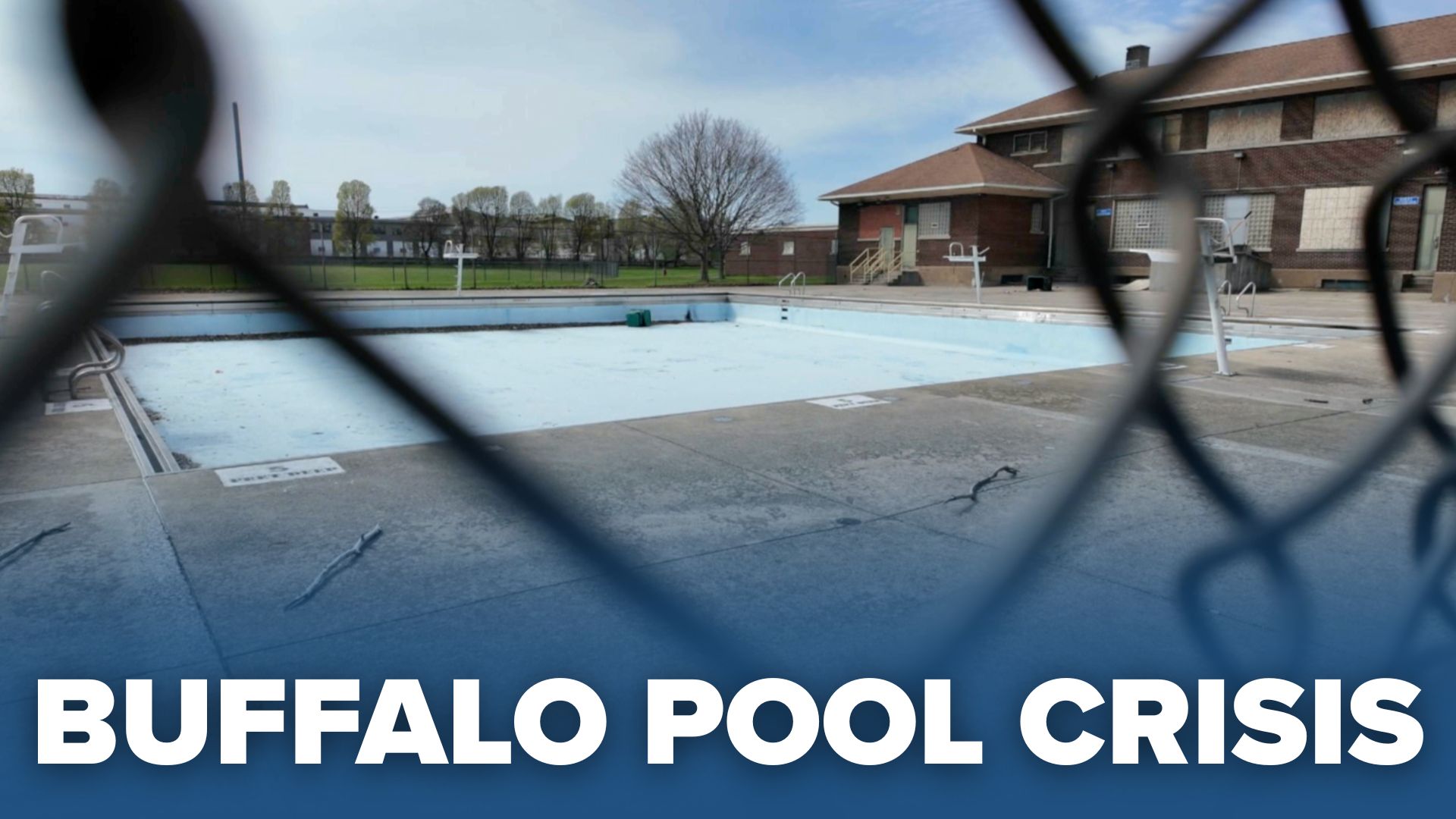


BUFFALO, N.Y. (WKBW) — Buffalo's swimming pools are in crisis. The city has lost half of its available pools in the last decade, leaving residents with few options to learn a skill that can save their lives.
Neglected facilities mean the indoor pool at Cazenovia Park in South Buffalo is now the only facility open year-round with accompanying learn-to-swim programming. That's a stark reality for a city on the shores of two Great Lakes.
"Swimming is the only sport where if you know how to do it, it has the ability to save your life," Mike Switalski said.
Switalski runs City Swim Project, which offers free or subsidized swim classes for kids. The program has been going since 2012 and teaches up to 500 children how to swim each year. But Switalski said more could be done if the city got more pools back online.
"We need to make a greater effort to get our facilities open, and open longer at times so families can enjoy them to teach their child the love of the water," Switalski said.
In 2015, the city listed 12 available public pools on its website and in historic press releases. This summer, only about half of that number will likely be available. Two pools have been permanently shuttered, two are closed for repairs, and the MLK Wading Pool operated by Olmsted Parks is no longer in use.
Buffalo's public pools:
Outdoor:
- Allison Pool: 50 Rees St. - Permanently closed
- Shoshone Pool: 467 Beard St. - Permanently closed
- Houghton Pool: 36 Spann St. - Closed for repairs
- Centennial Pool: 5 Porter Ave.
- JFK Pool 114 Hickory St.
- Kensington Pool: 369 Kensington Ave.
- Masten Pool 224 Best St.
- Riverside Pool: 2505 Niagara St.
Indoor:
- Lovejoy Pool: - Closed for repairs
- Cazenovia Pool: 626 Abbott Road.
Wading Pools:
- MLK Park Wading Pool: 175 North parade Ave. - not in use
- Crowley Wading Pool: Tonawanda & Crowley Streets - not in use
The remaining outdoor pools will only open this summer if the city can recruit enough lifeguards, something that has proven difficult in recent years. Switalski said that's the ripple effect of years of disinvestment, and it compounds over generations.
"We've put ourself in a dangerous cycle," Switalski said. "We're closing more pools, which means less accessibility, which means less people participating in aquatic sports, which means fewer people with the competent skills to become a lifeguard."
WATCH: 'A dangerous cycle': Buffalo's shrinking pool system leaves few options for city residents
Buffalo's Deputy Mayor Maria Whyte acknowledged the city's pool system is not good enough and said investment is the only way forward.
"The bottom line is we have to invest in it. We have to invest in infrastructure so pools can be open, we have to invest in the training for our lifeguards," Whyte said.
Whyte said she aims to pursue state and federal grants to fund improvements, but cautioned that it will take time. She said change for the better is coming, starting with improved programming this summer.
"We want to have enough staffing and lifeguards so there are lifeguards not only in the chairs but in the water working on learn to swim initiatives," she said.
A GENERATIONAL IMPACT
For some families, the stakes are deeply personal. Six-year-old Ashlyn is already breaking a generational cycle. Her mother, Ashley Kelley, never had year-round swim instruction growing up.
"She now knows how to swim better than me," Kelley said. "I grew up going to city pools; they were only open in the summer. I didn't have that year-round instruction," Kelley said. "Her being able to swim across this entire pool and back as a six-year-old is fantastic."
Kelley said she never received formal swim lessons and still doesn't know how to swim. Now, she's counting on her daughter.
"I still don't know how to swim now, so she's gonna save me if we're in an accident for sure," Kelley said.
And Ashlyn has a dream that may one day help to break the cycle.
"She really wants to grow up and be a lifeguard," Kelley said. "So, as we have all of these swimmers here, continue to have lessons, we'll have a lot of lifeguards growing up in the city that can come and teach swim, or just be in charge of the pools when they get to be 16."