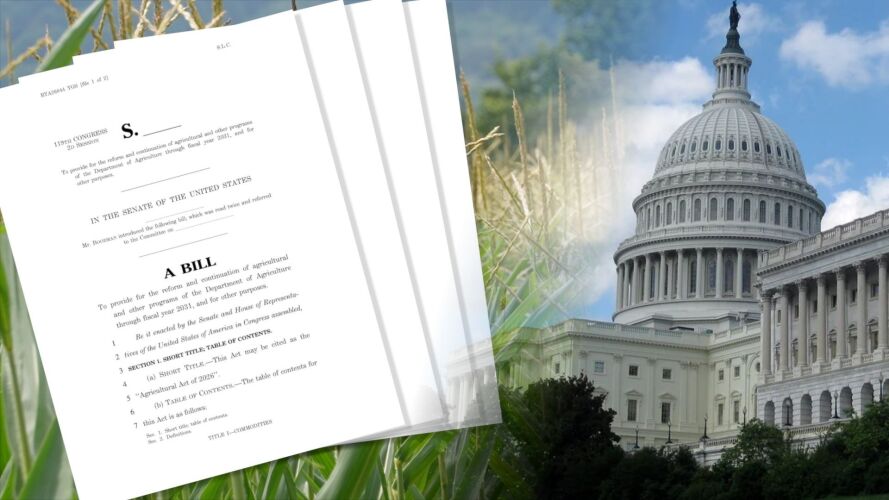


MAYVILLE, N.Y. (WKBW) — A bill meant to aid farmers all over the country has once again stalled on Capitol Hill, leaving its future uncertain and local advocates worried about the ramifications beyond the farm.
The Farm Bill is a package of legislation passed roughly once every five years that has a tremendous impact on farmers' livelihoods, how food is grown, and what kinds of food are grown.
The last version of the bill to be signed into law was in 2018, and it expired in 2023. Since then, the federal government has been funding agricultural efforts in staggered methods.

"But the fact remains, we don't have an indefinite amount of money to continue to do this," Jeff Winton, founder and chairperson for Rural Minds, a Mayville-based organization advocating for mental health awareness in rural communities, told WKBW.
"There is great fear that some of the consequential funding that has happened because this didn't pass will eventually start to go away because of the financial situation our government is facing right now." Winton continued, "We do know that there are several pieces that have just been holding on by the skin of their teeth since 2023, when the last farm bill expired, that could potentially just go away. That would be catastrophic for people in rural America."
In this most recent failure to pass the legislation, Winton says multiple political factors stalled the process.

Republicans and Democrats have many disagreements on SNAP benefits. Republicans want a one-year transition period for administrative control to be handed over to the states. Democrats want to extend the transition to two years.
The Food Research and Action Center (FRAC) criticized the one-year proposal, writing, "As a result, the proposal simply gives states another year to budget for this new cost. It does not give them another year for improvements in payment accuracy to be reflected in the payment error rates that determine their future financial obligations."
Additionally, FRAC wrote, "The proposal will further strain state budgets and force states to make impossible choices, such as paying for education or transportation, or keeping people fed."
According to Hunger Solutions New York, millions of New Yorkers rely on Farm Bill nutrition programs like SNAP to access healthy food to feed themselves and their families.
Winton told WKBW that the bill's failure also stemmed from one missing senator: Mitch McConnell.

"According to the rules with the Senate Agricultural Committee, votes that are received by proxy do not count, and so as a result of Senator McConnell's lack of attending this meeting in person, the bill failed by 10 to 11." Winton added, "It would have been tied and then because the Senate's the majority, it would have been passed."
McConnell was hospitalized in June after falling at his Kentucky home. He later developed pneumonia, complicating his recovery. Last week, McConnell revealed he was discharged from a rehabilitation center Thursday and will continue recovering at home.
When it comes to Rural Minds' mission, Winton says the bill could've improved access to mental health resources in rural areas and broadband internet as well.
"As many people know, in rural areas, including the Southern Tier, many families, including many of my own family members and neighbors, have no broadband. It's just not available."
"Our proposition is that if we can get broadband in more family homes, people will have the ability to access care for their mental health challenges because we clearly have a shortage of healthcare in rural America and especially mental health care." Winton continued, "So if people instead are able to access telehealth where they can be connected with a mental health provider, they will be much more likely to seek the help they need."
WATCH: Stalled Farm Bill leaves local farmers to deal with uncertainty amid rising costs
22.3 percent of Americans in rural areas and 27.7 percent of Americans in Tribal lands lack coverage from fixed terrestrial 25/3 Mbps broadband, as compared to only 1.5 percent of Americans in urban areas, according to a recent report by the Federal Communications Commission.
However, if the bill continues to stall, Winton says the impacts will be felt beyond the farm.
"There are a lot of ramifications if things aren't addressed in a more timely fashion than they have been; we may be importing more of our food from China, from South America. We may not be able to afford to continue to raise the food and fiber and produce the ethanol that we have taken for granted over the last several years."
So, already we're starting to see increased prices in grocery stores, and that's only going to continue with this uncertainty." Winton continued, "I know for a fact, you know, our fuel bill is much higher than it was before the war started. We did not apply any fertilizer this year because the price of fertilizer has been impacted because a good proportion of the components come from the Middle East and go through the Strait of Hormuz, that's been closed for some time."

Since the start of the Iran War, rural Americans have seen the highest gas prices in nearly four years—up 52 percent since February 27, before the war began.
"So, the farms are hurting right now. The farms in the southern tier are feeling this impact as they are in the Midwest, as they are on the West Coast, and even in other countries," Winton said.
Existing set-asides and priorities tied to the expiring 2018 Farm Bill authorities face uncertainty after September 30, 2026, unless extended through short-term continuing resolutions or other legislation.