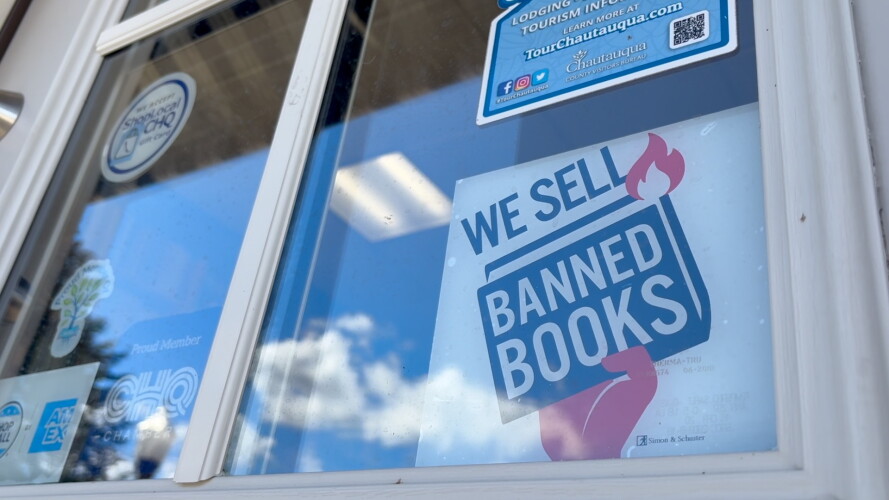


LAKEWOOD, N.Y. (WKBW) — Shops like Good Neighbor Bookstore in Lakewood take pride in selling banned books. However, its owner says a new report on the nearly 12,000 books banned last year should alarm everyone.
In a study by PEN America, 11,982 books were banned in public schools across the U.S. in 2025. The year saw a record number of unique titles banned, with 7,370 on the chopping block. Additionally, more than 4,500 of these were not previously recorded in PEN America's Index of School Book Bans.
The majority of the banned titles were categorized as Young Adult works, which Good Neighbor owner Bob Lingle said coincides with other "concerning" trends.
"Right now, the 12,000 books added to the banned book list over the year are written more by LGBTQ authors and minority authors, people that are putting the messages out there that may not be favorable of looking at the darker parts of American history," Lingle said. "It's putting people that don't have a voice in trying to remove their voice even further by banning their books."
WATCH: 'Could be anything in the future': Lakewood bookseller reacts to nationwide surge in book bans
According to PEN America, the majority of the bans stem from southern states. Texas accounted for over 8,000 entries, followed by Florida with 3,212. There were no reported or attempted book bans in New York State in 2025. However, Lingle said current legislation could make it easier for bans to be implemented.
H.R. 7661, or the Stop the Sexualization of Children Act, would amend the Elementary and Secondary Education Act of 1965 to "prohibit the use of funds provided under such Act to develop, facilitate, implement, host, or promote any program or activity for, or to provide or promote literature or other materials to, children under the age of 18 that includes sexually oriented material, and for other purposes."
Critics like Lingle said the bill's text is vaguely worded and could be abused. The bill defines sexually oriented material as material that "includes any depiction, description, or simulation of sexually explicit conduct" and "involves gender dysphoria or transgenderism."
A previous analysis by PEN America found that thousands of books banned over the past five years "consistently highlights that efforts to purge stories and books from schools have overwhelmingly targeted books about race and racism, LGBTQ+ people or characters, people or characters of color, and sex."
"While it's posed as kind of Save the Children, it's written so vaguely that it could be used to get rid of any book that somebody doesn't like, for any particular reason," Lingle said.
Back in New York, Governor Kathy Hochul faced criticism after vetoing The Freedom to Read Act. Senator Rachel May, Democrat for New York's 48th District and sponsor for the bill, called Hochul's veto "misguided and deeply frustrating."
“At a time when right-wing extremists are trying to purge libraries nationwide, Governor Hochul failed to step up and defend our rights," NYCLU Executive Director Donna Lieberman wrote in a statement following the veto. "The Governor's veto is a missed opportunity to combat censorship in New York and solidify students’ right to read free from viewpoint discrimination."
"While it is, the conversation this week is about banned books, it really becomes more of a First Amendment issue," Lingle said. "When it comes to attacks on the First Amendment where reporters are getting locked up, where in the past booksellers have been locked up, it becomes an issue that it shouldn't be a left, right, or middle issue. Everyone should be engaged and aware of the attacks that are going on because, well, it's books right now; it could be anything in the future."